
Have you ever assumed that piloting your device above the sea offers complete freedom, with no rules to follow?
Many pilots appreciate the beauty of capturing aerial footage over different environments. However, operating your equipment above land and large bodies of water presents fundamentally different challenges. Water-based missions serve many purposes, from creating stunning imagery to conducting vital inspections.
Whether your flight path takes you near the ocean, a beach, or a lake, specific preparation and awareness are essential. You remain responsible for checking airspace to avoid no-fly zones. General laws, like maintaining a visual line of sight, are just as important over these environments.
I want to share why these operations require specialised knowledge. This guide covers everything from pre-flight checks to emergency responses. My goal is to help you understand the risks and opportunities, ensuring your activities are both successful and safe.
Key Takeaways
- Operating a drone above water environments differs significantly from land-based flights.
- Specific preparation and awareness are crucial for safety over oceans, beaches, and lakes.
- Standard regulations, including visual line of sight, still apply during these operations.
- Pre-checking airspace is essential to avoid unexpectedly entering restricted zones.
- Proper planning recognises the inherent risks while unlocking beautiful photographic opportunities.
- This guide offers specialised tips for successful and secure water-based flight operations.
Pre-flight Preparations and Essential Settings
Proper configuration before launching your aerial device near large bodies of water can make the difference between success and failure. I always begin my preparations on solid ground to ensure everything works perfectly.
Calibrating Sensors on Land
I make it a rule to calibrate my compass and IMU on stable land before any aquatic operation. The metal construction of boats can interfere with compass readings, causing potential errors.
IMU calibration requires a perfectly still, flat surface. This is nearly impossible to achieve on a moving vessel. Starting with accurate sensor readings prevents many issues later.
Adjusting Advanced Settings
When operating from a boat, I keep my equipment well away from engine rooms and motors. Electromagnetic energy from these areas can disrupt the compass.
The downward vision positioning system maps surfaces below to assist with positioning. However, light reflecting off water can confuse this system, leading to instability.
I recommend maintaining height over two metres to minimise VPS interference. If flying lower, turning off VPS might be necessary, though this requires more manual altitude control.
| Sensor Setting | Land Operation | Water Operation | Recommended Adjustment |
|---|---|---|---|
| Compass | Standard calibration | Pre-calibrate on land | Avoid metal interference |
| IMU | Level surface calibration | Land-based setup essential | Ensure perfect stillness |
| VPS | Usually enabled | Consider disabling below 2m | Monitor for water reflection issues |
Disabling the positioning system affects precise landing capabilities. You’ll need extra caution during approach when this feature is turned off.
Understanding the Risks of Operating Over Water
When planning missions across lakes, oceans, or coastal areas, several distinct hazards require careful evaluation. I’ve learned that recognising these dangers early prevents most problems during aquatic operations.
Weather Conditions and Strong Winds
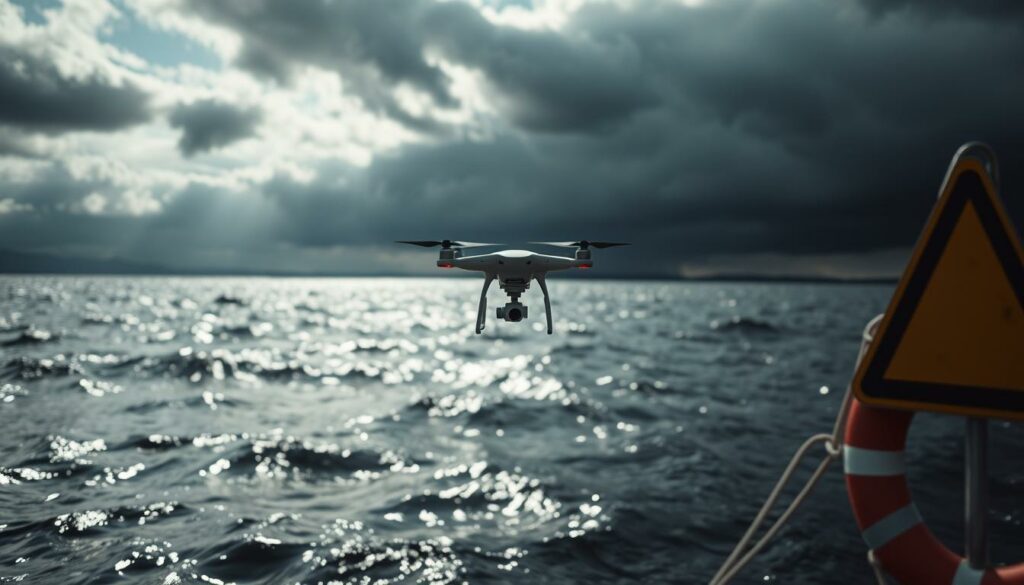
Strong winds pose one of the greatest threats above open water. They affect flight stability dramatically and reduce battery life significantly.
The force of wind increases with altitude, making higher operations particularly challenging. I always check weather forecasts thoroughly before any mission.
Spontaneous downpours can damage equipment unexpectedly. Monitoring changing conditions becomes essential for safe operations.
Interference from Natural and Man-made Objects
Various objects can disrupt signals during water missions. Lighthouses, ships with antennas, and Wi-Fi devices interfere with compass GPS readings.
Natural objects like shoreline trees, rocks, and birds present collision risks. Birds become more aggressive near their colonies, requiring safe distances.
GNSS disruption causes multipathing and positional inaccuracies over water. I constantly monitor my equipment’s positioning systems.
Moving boats demand constant observation to avoid collisions. Paying attention to your surroundings helps identify hazards before takeoff.
Navigating Safety in Water Environments
Two factors consistently challenge even experienced pilots when operating above marine environments: surface dynamics and vessel traffic. Both demand constant observation and quick decision-making.
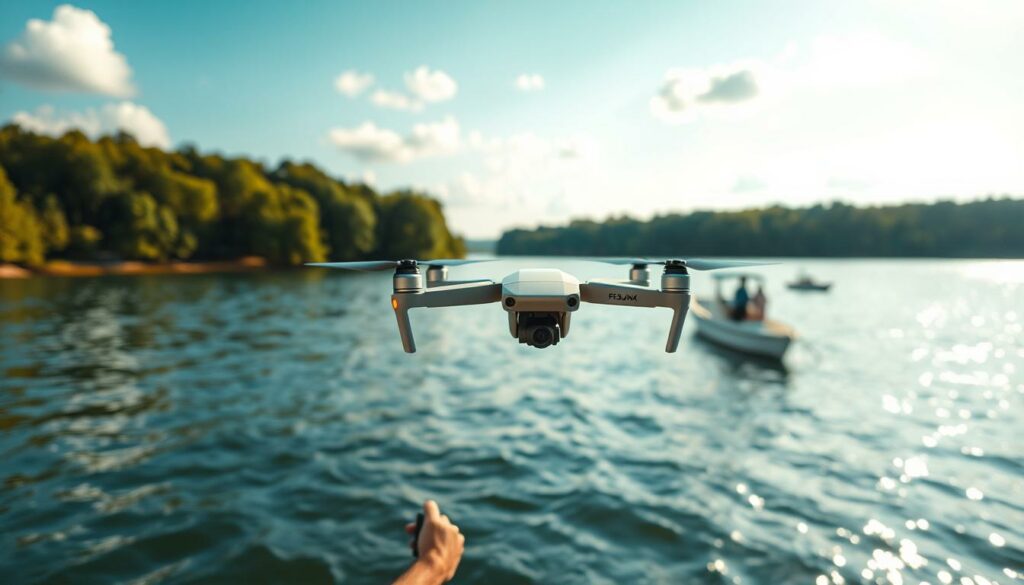
Success in these conditions requires dividing your attention between multiple elements. You must monitor your equipment, the water below, and any vessels around you.
Managing Waves and Avoiding Boats
Surface movements present one of the most underestimated dangers. Even small ripples can reach surprising heights during your flight.
I maintain a generous altitude buffer above the water’s surface. This gives me time to react if waves suddenly grow larger. Constant assessment of wave patterns is essential throughout the operation.
Moving vessels require equal attention. I keep all boats under constant observation to avoid collision risks. Maintaining safe distances protects both my equipment and the people on board.
Boat wakes create wave patterns that extend far beyond the vessel itself. Visual scanning techniques help me track multiple boats in busy environments. This divided attention strategy ensures comprehensive safety coverage.
Expert Tips for Flying Drone Over Water
Expert advice can transform your aquatic aerial photography from risky to remarkable. I want to share techniques that keep your equipment safe while capturing stunning footage.
Maintaining Visual Line of Sight and Safe Altitudes
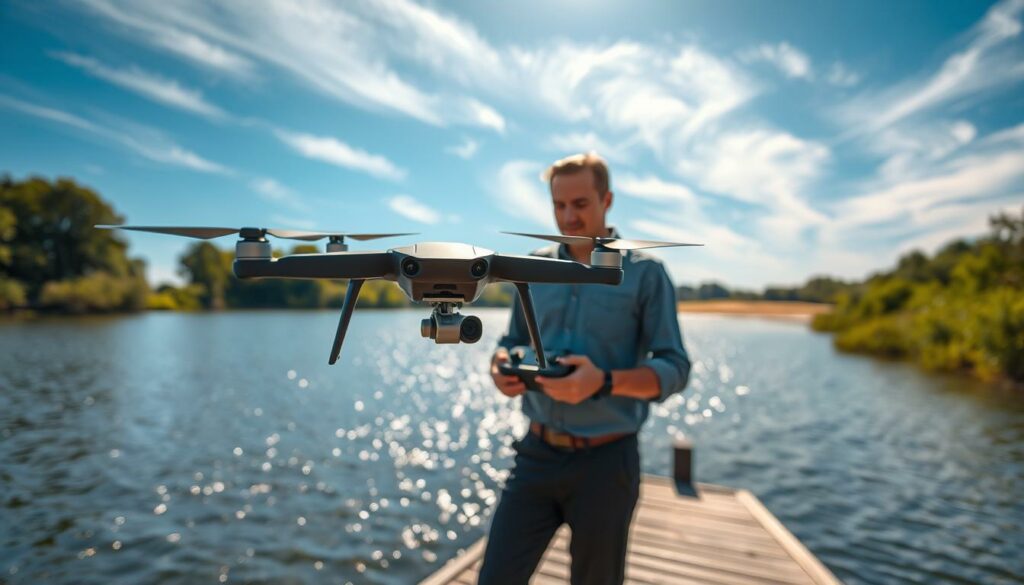
I always resist pushing beyond my visual line of sight, even for perfect shots. Keeping your device within view ensures immediate control during unexpected situations.
When operating at low height, maintain at least 1-1.5 metres above the surface. This buffer prevents accidental contact with waves while allowing stable footage capture.
Implementing Failsafe and Return-to-Home Adjustments
Your home point setting becomes critical when launching from boats. Since vessels drift, I disable Return-to-Home functionality to avoid water landings.
Instead, I configure my failsafe to hover mode. This gives me precious time to manually navigate back to my position before landing.
Dealing with Electromagnetic Interference on Boats
Boat engines create significant electromagnetic interference that affects GPS signals. I keep my equipment well away from motors and electronic systems.
Constant attention to telemetry data helps me spot positioning issues early. Being ready to switch to Attitude mode ensures I maintain control if GPS fails.
Takeoff and Landing Best Practices
Successful operations from a boat demand a complete rethink of your standard takeoff and landing routines. The moving, drifting nature of the vessel adds layers of complexity that you simply don’t face on solid ground.
Operating from a Moving Boat or Ship
Metal hulls can seriously interfere with your compass. I always elevate my launch platform using a simple wooden pallet. This creates crucial distance from the boat’s structure.
Another option is a hand launch. I launch the aircraft from my palm to avoid compass errors entirely. It requires a steady hand but is very effective.
Once airborne, my first move is a rapid vertical ascent. I fly straight up, clearing the tallest part of the vessel immediately. This prevents any risk of collision.
Manual Landing Techniques and Emergency Responses
The biggest risk is your home point. A standard GPS location recorded at takeoff becomes useless if the boat has drifted. Your aircraft could attempt to land in the sea.
I always disable the automatic return function. Instead, I use the dynamic “Home Point Me” feature. This updates the return location to my controller’s current position.
Manual control is your safest backup. I practise landing the device directly into my hand. Watching its approach lets me cancel an automatic return if it looks risky.
| Launch/Landing Method | Best For | Key Consideration |
|---|---|---|
| Elevated Platform (Wood) | Stable, hands-free operation | Reduces metal interference significantly |
| Hand Launch/Catch | High-metal-content boats | Requires skill and confidence |
| Standard Deck Launch | Not recommended | High risk of compass errors |
Preparing for Unpredictable Water Conditions
Building operational competence begins with extensive land-based training before venturing into more demanding water-based scenarios. I always dedicate significant time to developing my skills on solid ground first.
Practising Skills on Land Before Water Flights
Mastering takeoff, flight, and landing techniques on stable terrain is essential. I recommend creating a detailed plan on paper before any operation.
Testing camera angles and equipment settings in predictable environments builds confidence. This preparation time eliminates unnecessary risks when facing challenging conditions.
Setting Up for Unstable Environments and Wind Gusts
Water surfaces create unique challenges with increased wind speed and unpredictable gusts. I practise handling these conditions during land sessions.
Simulating unstable environments helps develop the quick reactions needed for successful aquatic operations. Proper preparation genuinely minimises the inherent risks.
Visualising your end goal and planning the flight path brings peace of mind. The better your control through practice, the safer your experience will be.
Conclusion
As we conclude our exploration of aerial operations near aquatic settings, remember that each successful mission begins long before takeoff. Proper preparation—from compass calibration to home point configuration—makes the critical difference in these challenging environments.
I always make sure to disable the positioning system feature to avoid confusion from surface reflections. Maintaining visual sight, controlling your height, and managing speed remain interconnected safety factors that demand constant attention.
After any flight, remove water residue by aerating your equipment or using silicone packs. Consider insurance options that cover water damage, as even careful operation carries inherent risks.
With proper preparation and respect for your surroundings—including birds, boats, and changing conditions—you can safely capture stunning footage. Remember that one moment of carelessness could result in losing your valuable equipment.
FAQ
What are the most important pre-flight checks I should do?
I always start by calibrating my compass and IMU on a flat, stable piece of land. I also double-check my return-to-home settings, ensuring the home point is recorded correctly and the battery failsafe is set to a safe percentage.
How can I keep my drone safe from interference when flying near boats?
Electromagnetic interference from a boat’s electronics can be a real issue. I maintain a good distance and altitude from the vessel, and I make sure my GPS signal is strong before I launch to help the drone maintain its positioning.
Is it safe to take off and land from a moving boat?
This is a tricky one that requires practice. I only attempt it in calm conditions, making sure the boat is moving slowly and steadily. Hand-catching for landing is my preferred method to avoid any instability from the deck’s movement.
What should I do if I lose sight of my drone over the water?
My first action is to stay calm. I immediately check my controller’s screen for the live feed and the aircraft’s location on the map. If I can’t re-establish a visual line of sight, I’ll use the return-to-home feature to bring it back safely.
How does flying over water affect the drone’s sensors?
The Vision Positioning System (VPS) can struggle because the water’s surface lacks distinct features for it to track. I disable VPS for water operations and rely solely on GPS for stable hovering, which gives me much better control.
What is the best way to handle windy conditions near the ocean?
Coastal winds can be unpredictable. I always check the forecast and fly at a higher altitude where winds are often stronger. I also keep my flight times shorter and maintain a lower speed to conserve battery power against the resistance.