
What if I told you that the most breathtaking aerial footage doesn’t come from pushing limits, but from mastering control? I’ve crafted this guide because I believe every stunning piece of videography should be built on a foundation of responsibility.
Over the years, I’ve learned that true expertise isn’t just about technical skill. It’s about understanding how being a conscientious drone pilot actually unlocks greater creative freedom. This philosophy has protected my equipment, the public, and ultimately, the quality of my work.
In this guide, I’ll share practical tips from my experiences flying drones in diverse conditions. We’ll explore how combining knowledge with awareness enhances your possibilities, rather than restricting them. My aim is to offer real-world insights in a friendly, personal manner.
Key Takeaways
- Responsible flying is the foundation for capturing superior aerial footage.
- Safety awareness enhances creative possibilities instead of limiting them.
- This guide offers practical advice drawn from extensive real-world experience.
- Protecting people and property is a fundamental part of professional videography.
- Technical knowledge and safety consciousness are equally important for a drone pilot.
- A personal, experienced-based approach makes learning these skills more accessible.
Introduction and the Importance of Safe Drone Flying
My journey with unmanned aerial vehicles began almost a decade ago, starting as casual weekend flights that gradually became daily practice. What began in 2014 as occasional hobbyist sessions has evolved into operating my equipment multiple times weekly when conditions permit.
My Personal Journey in Drone Flying
This consistent practice taught me that regular flying builds the muscle memory needed for confident control. The transition from infrequent to regular operation was transformative. Each session added to my experience bank, making complex manoeuvres feel natural over time.
Why Safety is Essential for Capturing Great Shots
These aerial devices have completely changed how we create visual content. They offer perspectives once reserved for helicopter crews at a fraction of the cost. This accessibility opens incredible creative possibilities for content makers.
Being safety-conscious isn’t about restriction—it’s about enabling better work. When you’re confident in your control and aware of your surroundings, you can focus entirely on composition. Proper preparation lets you push creative boundaries while maintaining responsibility.
Mastering conscientious operation is indeed a journey requiring dedication. The rewards in terms of shot quality and peace of mind make every hour of practice worthwhile.
Pre-flight Preparation and Research
The most productive aerial sessions often begin long before I power on my equipment, with careful digital reconnaissance. This groundwork ensures I make the most of my limited time on location, saving precious battery power for capturing footage, not just scouting.
Researching Your Shoot Location Using Google Maps
I rely heavily on Google Maps to virtually explore a new area. This allows me to identify potential obstacles, interesting angles, and safe take-off/landing spots. It turns a potential gamble into a strategic shoot.
Assessing Weather and Light Conditions
Understanding the weather is non-negotiable. I check forecasts meticulously for wind, rain, and temperature. Calm conditions at sunrise or sunset are my ideal time for flying.
This golden hour provides beautiful, soft light that is perfect for both photography and videography. I use sun position calculators to know exactly where the light will fall on my subject.
Mornings often offer a calm window and fewer people, making them my preferred time. Proper preparation transforms a flight from risky to remarkably efficient.
Mastering the Basics of Drone Flight
Many people believe that flying frequently automatically improves your skills, but I’ve discovered there’s a crucial difference between just flying and purposeful practice. Simply moving your equipment up, down, and around teaches you very little after the initial learning phase.
I regularly schedule sessions dedicated solely to improving my abilities rather than capturing content. This focused approach has dramatically enhanced my capabilities as a pilot. The key is pushing beyond your comfort zone while maintaining safe operations.
Building Confidence Through Regular Practice
I’m fortunate to have access to private woodland where I can practice without risk to others. Here, I challenge myself by flying at low heights of just 3-9 feet, navigating tight gaps between branches and trees.
Adding slow rotations while moving through these obstacles significantly improves my dexterity and handling. What feels challenging in practice makes standard flights feel effortless later.
Mastering the basics drone control is the foundation for all advanced techniques. Finding safe environments like private fields allows you to experiment and build fundamental skills confidently.
This approach transforms your relationship with the equipment from nervous uncertainty to confident control. Purposeful practice sessions are investments that pay dividends in every future flight.
Drone Safety for Videographers: Essential Tips
One of the biggest breakthroughs in my aerial work came when I stopped relying on factory defaults. Customising your equipment’s response transforms amateur footage into professional-grade content.

Adjusting Control Stick Sensitivity and Camera Settings
Many pilots never touch their control stick sensitivity settings, which is a missed opportunity. Fine-tuning these parameters gives you much finer drone control over movements.
For DJI users, adjusting the gimbal’s yaw smoothness and rotation speed makes a huge difference. You can also customise pitch speed settings to match your shooting style. These adjustments create buttery-smooth camera movements that elevate your work.
Avoiding Automatic Modes for Greater Creative Control
Automatic modes might seem convenient, but they limit your growth as a content creator. When the equipment makes decisions for you, you miss valuable learning opportunities.
Switching to manual settings gives you complete creative authority over your footage. This approach develops your technical understanding while producing unique results. Manual control separates professional videography from generic aerial shots.
Experiment with different sensitivity levels to find what works for your style. These simple tips can revolutionise your aerial content creation journey.
Techniques for Capturing Smooth Aerial Footage
The transition from still photography to motion content creation revealed a crucial technical gap in my approach to aerial work. Initially focusing on photography meant I could overlook certain elements that became essential for quality motion content.
Using ND Filters to Achieve the Perfect Shutter Speed
Many creators mistakenly believe smooth movement means moving slowly. True smoothness comes from eliminating jerky motions and rotations. This distinction transformed my results.
Neutral density filters became my essential tool for filming. With fixed aperture equipment, these filters control light intake, allowing proper shutter speed settings. Following the 180-degree rule, I aim for 1/50 second at 24 frames per second.
Without ND filters, the camera often uses speeds like 1/1000 to prevent overexposure. This creates stuttering content lacking natural motion blur. Brands like Freewell offer excellent solutions for this challenge.
Perfecting Slow and Steady Moves
Panning techniques require careful distance consideration. The closer you are to your subject, the slower your movement must be. Greater distance allows faster panning without stutter.
When shot with proper settings in good conditions, aerial content rarely needs post-production stabilisation. Mastering these techniques elevates your work from amateur to professional quality, making your shots stand out remarkably.
Understanding and Navigating UK Legal Regulations
When I first started operating aerial equipment commercially, I quickly realised that understanding legal requirements was just as important as mastering flight techniques. The UK’s aviation framework exists to protect everyone.
Complying with No-Fly Zones and CAA Requirements
The Civil Aviation Authority sets clear rules for commercial operations. Anyone capturing aerial content for business needs proper permission. This certification process ensures competency.
Crowd regulations are particularly important. For groups of 1-1000 people, equipment must stay 50 metres away unless everyone consents. For larger crowds exceeding 1000, the distance increases to 150 metres regardless of consent.
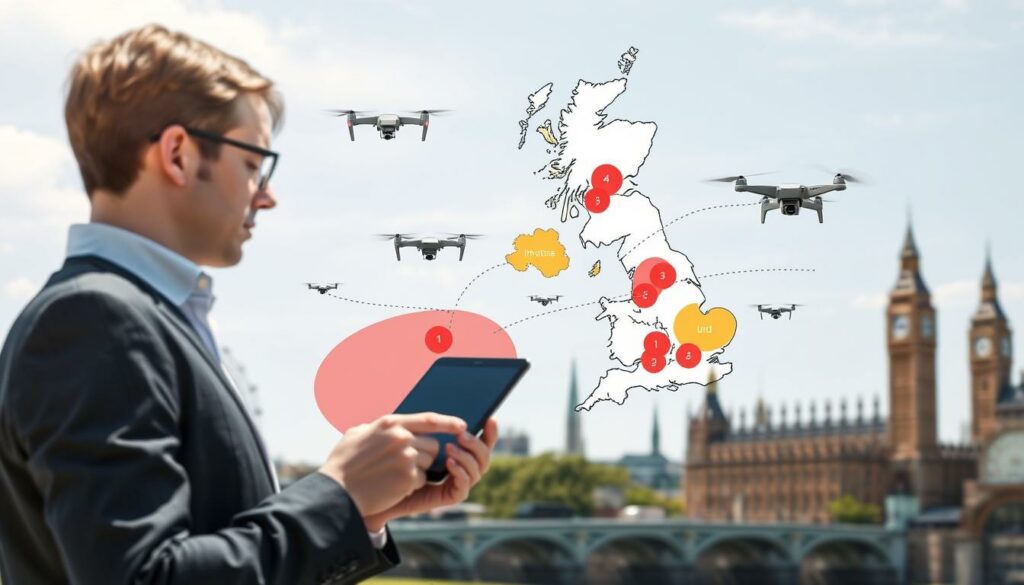
Understanding no-fly zones is essential. Restricted areas include spaces near military bases, airports, and other sensitive locations. Many apps provide real-time information about these prohibited zones.
Illegal operators pose significant risks. An unqualified individual lacks the training of a certified professional. If you witness questionable operations, ask to see their CAA PfCO certification.
Misuse can result in fines up to £5,000. Following all regulations before each flight protects your work and maintains industry standards. Proper certification isn’t restrictive—it enables professional opportunities.
Managing Drone Batteries and Technical Set-Up
Nothing cuts a creative session short quite like the urgent beep of a low-power warning. Proper power management is arguably the most critical technical skill for any pilot. It separates a smooth, productive day from a potential disaster.
Most modern units offer around 30 minutes of flight time in ideal situations. However, this estimated life is just a starting point. Real-world factors like wind resistance or heavy camera use can drain power much faster.
Tips for Efficient Battery Management
I’ve developed a strict routine to maximise my shooting time and ensure a safe return. It starts long before takeoff.
- Always start fully charged: I never assume a battery has enough life from its last use. A full charge is non-negotiable for every session.
- Monitor constantly: Keep a close eye on the battery percentage throughout the entire flight. Do not wait for the first low-power alert.
- Plan your path: Before launch, know exactly where you need to go. This allows you to calculate how much power you need to conserve for the return journey.
I always carry spare batteries. This simple habit eliminates the pressure to squeeze one more shot from a nearly empty cell. It also lets you work calmly, knowing you have backup power available.
Avoid flying in extreme conditions. Very cold or hot weather significantly impacts battery performance. Preserving your power source is essential for maintaining control from start to finish.
Overcoming Common Challenges in Drone Filming
There’s a moment every pilot dreads: the sudden flicker on your controller screen indicating signal trouble. These technical hiccups can transform a smooth session into a stressful situation quickly. Understanding how to prevent and manage them is crucial for consistent results.
Urban landscapes packed with wireless signals create particular challenges. Cell towers, power lines, and dense infrastructure can disrupt your connection. This interference might cause unpredictable behaviour or complete signal loss.
Dealing with Signal Interference and GPS Loss
Before each outing, I always check my equipment’s GPS signal strength. A robust connection is your first defence against problems. I avoid areas near large metal structures where interference risks increase significantly.

Modern units handle wind better than earlier models, but there are limits. Gusty conditions make stabilisation systems work harder, affecting your final product. Choosing calmer days helps ensure smooth, professional-looking results.
If trouble arises during operation, staying calm is essential. Most contemporary systems have automatic return-to-home functions that can save your equipment. Being prepared for these common issues makes every aerial session more successful.
Weather conditions impact both stability and visual quality. Challenging environments not only affect your control but compromise the footage you’re trying to capture. Planning around these factors separates amateur attempts from professional drone filming.
Best Practices for Using Drone Controls and Settings
What transforms basic flying into cinematic artistry is the ability to combine movements with seamless precision. The quality of your aerial work depends heavily on your technical skills and creative approach to movement combinations.
Customising Your Drone’s Output for Smooth Movement
I’ve found that combining two or more movements creates the most engaging drone footage. For example, rising while slowly rotating adds cinematic quality to your shots. This technique elevates simple footage into professional-grade content.
Once confident with basic commands, push yourself to handle multiple controls simultaneously. Varying your speed and movement combinations creates more dynamic drone videos. Customising your equipment’s response settings is crucial for achieving this smooth output.
Training in Varied Environments to Enhance Dexterity
Different locations challenge your skills in unique ways, improving overall handling. While many drones have similar capabilities, it’s the pilot’s creativity that determines spectacular results.
I recommend studying exceptional drone videography online for inspiration. However, develop your own style rather than simply copying others. This approach ensures your work stands out with authentic character.
Conclusion
What separates memorable aerial content from ordinary footage is the thoughtful approach behind each flight. Throughout this guide, I’ve shared how putting safety first enhances both your creative output and professional standing.
The journey from basic operation to capturing professional drone footage combines technical knowledge with regular practice. Understanding UK regulations and mastering your equipment’s settings are equally important.
Whether your focus is drone videography or aerial photography, the principles remain consistent. Proper preparation, equipment care, and continuous learning create the foundation for exceptional shots.
I hope this guide helps you find that perfect point where skill meets creativity. The true golden hour occurs when safety consciousness and technical mastery converge to produce stunning results.
FAQ
What is the most important piece of advice for a new pilot?
My top tip is to always put safety first. Before you even think about getting that perfect shot, you must be confident in your basic flying skills. This means practising in a wide-open space away from people and property until handling the aircraft feels like second nature.
How can I check if it’s legal to fly my aircraft in a specific area?
I always use official resources like the Civil Aviation Authority’s (CAA) Drone Assist app or website. These tools show you live maps of no-fly zones, including near airports and restricted airspace. It’s my essential first step for any filming location to ensure I’m complying with all UK regulations.
What weather conditions should I avoid when planning a flight?
I am very cautious about wind and rain. Strong gusts can make control difficult and ruin the stability of your footage. Even light rain can damage the electronics. I also avoid flying in poor light, as it negatively impacts image quality. Checking the forecast meticulously is a non-negotiable part of my pre-flight routine.
Why is practising with the control sticks so important for getting good footage?
Smooth footage comes from smooth inputs. When I first started, my movements were jerky, which showed in the final video. By spending time just flying—without filming—I built the muscle memory needed for slow, cinematic moves. It’s the foundation for all professional-looking aerial photography.
Can you explain how an ND filter helps with my camera settings?
Absolutely! An ND filter is like sunglasses for your lens. It reduces the amount of light entering the camera. This allows me to use a slower shutter speed, even in bright conditions like the golden hour. The result is more motion blur between frames, which gives your video a much smoother, more cinematic look.
What is your best advice for managing battery life during a shoot?
I never push my batteries to their limit. I plan my flights so that I land with at least 20-30% power remaining. This gives me a safety buffer for unexpected wind or a complicated landing. I also always carry spares and keep them warm in cold weather, as low temperatures can drastically reduce flight time.