
Have you ever wondered what it truly takes to capture Italy’s breathtaking landscapes from above without running into legal trouble? Many pilots assume that flying their unmanned aircraft in this beautiful country is straightforward, but the reality is more complex than you might think.
I’ve discovered that operating these flying devices in Italian airspace requires careful navigation of both European Union frameworks and specific national provisions. The foundation stems from EU Regulations that came into effect at the end of 2020, creating a standardised approach across member states.
Italy’s Civil Aviation Authority, known as ENAC, has built upon this foundation with its own UAS-IT regulations. This ensures that whether you’re flying for fun or commercial purposes, you’re operating within a clear legal structure. The system applies equally to Italian residents and visitors from other EU countries.
One crucial aspect I’ll guide you through is the mandatory liability insurance requirement. This protects both operators and the public. Additionally, Italy’s D-Flight platform serves as your central hub for registration and airspace information, showing real-time no-fly zones.
This comprehensive guide will walk you through every step needed for compliant operation. You’ll learn about certification processes, practical flying guidelines, and how to avoid penalties while enjoying Italy’s stunning vistas from unique perspectives.
Key Takeaways
- EU regulations form the basis for operating unmanned aircraft in Italian airspace
- ENAC serves as Italy’s primary aviation authority with specific national provisions
- Liability insurance is mandatory for all flying activities in the country
- The D-Flight platform provides essential registration services and airspace data
- Regulations apply equally to Italian citizens and international operators
- Proper registration and certification are required before any flight operations
- Real-time information about restricted zones is available through official channels
Understanding Drone Laws Italy 2026
The legal landscape for operating unmanned aircraft in Italy is built upon a dual-layered foundation of European and national rules. This structure ensures a high standard of safety and clear expectations for all pilots.
At the European level, the cornerstone is formed by specific EU regulations. These set a harmonised standard across member states, which Italy has fully adopted. This means the core rules are consistent whether you’re flying in Rome or Rotterdam.
Legal Framework and EU Regulations
A key innovation of this European framework is its risk-based approach. Operations are sorted into three categories: Open, Specific, and Certified. This system moves away from labelling flights as purely recreational or commercial.
Instead, the focus is on the potential risk involved. The category your flight falls into depends on factors like the aircraft’s weight and how you plan to use it. This creates a more logical and safety-focused set of regulations.
National Provisions and Compliance in Italy
Italy’s national aviation authority, ENAC, implements these EU rules through its own detailed provisions. This adds a layer of specific national compliance requirements.
Every operator is responsible for understanding these rules. This includes adhering to safety protocols, data protection laws, and securing mandatory insurance. The table below summarises the three main operational categories.
| Category | Risk Level | Typical Requirements |
|---|---|---|
| Open | Low | CE class label, basic operator registration |
| Specific | Medium | Operational authorisation, risk assessment |
| Certified | High | Certified aircraft, licensed pilot |
This framework, managed by the aviation authority, prioritises safety while allowing responsible operators the freedom to fly. There are no barriers based on nationality, making the skies accessible to all who follow the regulation.
Navigating Italy’s Drone Certification and Licensing
Before you can take to the skies, understanding the certification process is essential for compliance. I’ve found that getting your paperwork sorted early makes flying much smoother.
Registration Process and Operator Identification
Registration is your first step. Most operators need to register via the D-Flight platform. There are exceptions for very lightweight aircraft without cameras.
The system focuses on the operator rather than individual aircraft. You get one unique registration number that covers all your flying devices. This identification must be visible on each aircraft.

D-Flight costs €6 monthly. Your registration number works across all EASA member states. This makes cross-border operations straightforward.
EU Drone Certificate: A1-A3 vs A2 Distinctions
For aircraft over 250g, you’ll need a certificate of competence. The basic A1-A3 qualification requires online training and an exam.
This course covers essential operational principles. You’ll study the manufacturer’s manual and complete theoretical knowledge testing.
The A2 certificate allows operations closer to people. It needs additional practical training and a more comprehensive 30-question exam.
ENAC charges €90 per hour for processing. Most applications take 4-5 hours. These certificates demonstrate your competence and understanding of safety protocols.
Both qualifications are delivered online. This makes the process accessible throughout the country without needing physical attendance.
Practical Guidelines for Flying Drones in Italy
Operating your aircraft responsibly means adhering to specific safety checks and flight boundaries. I’ve found that understanding these practical rules makes flying both safer and more enjoyable.
Before any flight, thorough preparation ensures you stay within legal limits. The open category has clear restrictions that protect people and property.
Safety Checks and Operational Limits
All flights must maintain visual line of sight with your device. This means keeping it within 500 metres and always visible to you.
The maximum altitude is strictly limited to 120 metres. This keeps your aircraft well below manned aviation routes.
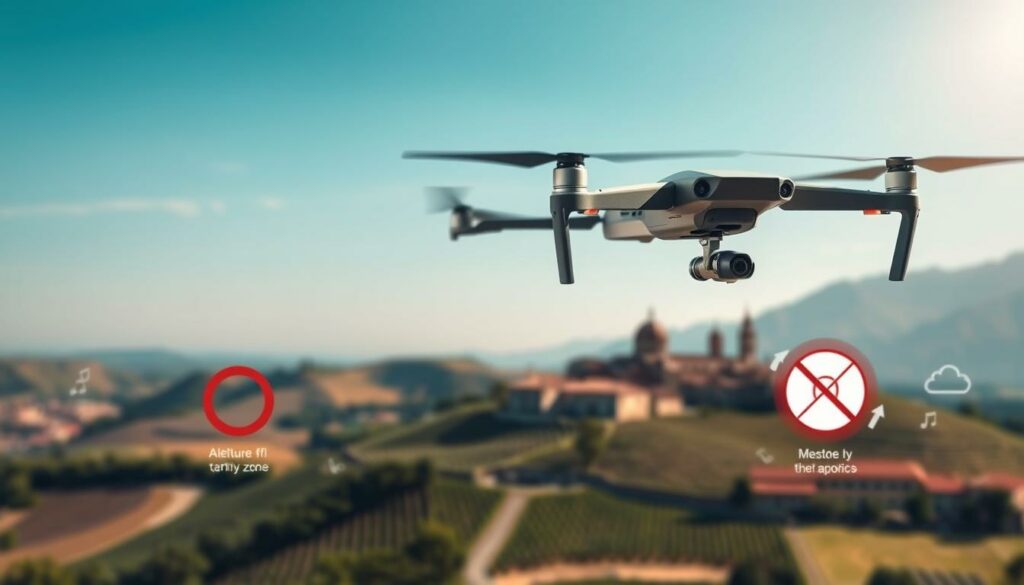
Flying is only permitted during daylight hours. Night operations require special authorisation from the civil aviation authority.
You must avoid airports and military zones completely. The D-Flight system provides real-time data on restricted areas.
| Certificate Type | Minimum Distance from People | Building Operations | Training Requirements |
|---|---|---|---|
| A1-A3 | 150 metres from buildings | Restricted near structures | Online course and exam |
| A2 | 50 metres from people | Permitted above buildings | Additional practical training |
Pre-flight checks include weather assessment and equipment inspection. Verify battery levels and mechanical condition before every operation.
Your aircraft must carry the correct CE label. This confirms it meets European safety standards for its category.
Contact regional ENAC offices for specific area guidance. They provide authoritative advice on local flying conditions.
Conclusion
As we wrap up this guide, remember that responsible aerial photography starts with compliance and safety consciousness. Mastering the European framework, obtaining proper certification, and respecting operational boundaries are essential for every pilot.
The Italian civil aviation authority, ENAC, provides comprehensive guidance on their website. The D-Flight platform remains your go-to resource for registration and real-time airspace information. While costs like the €6 monthly subscription and operational fees from €94 exist, they ensure legal compliance.
Choose your certificate wisely – the A2 offers more flexibility but requires additional investment. Stay informed about updates and maintain your qualifications. This approach guarantees safe, enjoyable flying experiences while respecting Italy’s beautiful landscapes and communities.
FAQ
What is the very first thing I need to do before I fly my unmanned aircraft in Italy?
The absolute first step is to register yourself as an operator with the national aviation authority, which is ENAC (Ente Nazionale per l’Aviazione Civile). You’ll get a unique operator identification number that you must mark on all your aircraft.
Do I need a specific certificate to be a remote pilot, and how do I get one?
Yes, for most flights, you need a remote pilot certificate. For the ‘open’ category, you typically complete an online training course and pass a theoretical exam on the official national aviation authority portal to receive your competency acknowledgement.
I’m confused about the different categories like A1/A3 and A2. Can you explain the main difference?
Certainly! The main distinction lies in the weight of your aircraft and where you can fly. The A1/A3 certificate is for lighter models, often flown far from people. The A2 Certificate of Competence involves more rigorous training and a practical exam, allowing you to fly slightly closer to individuals with certain aircraft.
Where am I absolutely not allowed to fly my unmanned aerial vehicle?
You must always avoid restricted areas. These include spaces near airports, military zones, crowded city centres, and many national parks. I always use an official ‘geo-awareness’ map or app to check for real-time no-fly zones before any operation.
Are there any special rules about keeping my aircraft in sight during a flight?
Yes, maintaining visual line of sight is a fundamental rule. This means you must always be able to see your aircraft with your own eyes (not through goggles or a screen alone) to control its flight path and avoid other airspace users and obstacles.
What happens if I don’t follow these regulations?
Non-compliance can lead to significant penalties from ENAC, including heavy fines and the potential confiscation of your equipment. It’s crucial to understand and adhere to all the rules to ensure safe and legal flights.