
Have you ever returned from a flight, excited to review your aerial captures, only to find the footage is disappointingly shaky and unusable? This frustrating experience is all too common for many pilots. The difference between amateur and professional results often comes down to one crucial factor: how effectively your equipment handles movement.
I’m diving into the world of keeping your camera steady mid-flight. Achieving butter-smooth cinematic shots isn’t magic; it’s the result of sophisticated technology working behind the scenes. This technology transforms what you see through your viewfinder into stable, professional-grade content.
In this guide, I’ll compare the two main approaches that have revolutionised airborne imaging. We’ll explore the mechanical marvel of the 3-axis gimbal system alongside clever digital techniques. My goal is to break down the technical aspects in a friendly, accessible way, helping you make an informed choice for your aerial photography and videography projects.
Key Takeaways
- Stable footage is essential for professional aerial videography and photography.
- Unwanted camera movements can ruin otherwise breathtaking aerial views.
- Two primary approaches exist: mechanical gimbal systems and digital stabilisation techniques.
- Understanding these systems helps you choose the right tool for your needs and budget.
- The right stabilisation technology elevates your content from amateur to professional standard.
- This knowledge applies to equipment ranging from consumer models to professional cinema gear.
Introduction to Drone Stabilisation
Achieving professional-looking results from above requires overcoming the natural challenges of keeping your camera steady during flight. I want to help you understand why this matters and what you’re up against when capturing aerial content.
Understanding the Importance of Stable Footage
Smooth footage isn’t just a luxury—it’s essential for anyone serious about aerial work. Whether you’re creating social media content or professional films, stable imaging makes your work look polished and credible.
Unstable recordings show up as jitters, shakes, and blurry images that distract viewers. These issues can ruin otherwise spectacular views and make your content appear amateurish.
Overview of Common Challenges in Aerial Videography
Flying platforms face unique obstacles that ground-based photography doesn’t encounter. Wind gusts, turbulence, and rapid movements create constant instability that requires specialised solutions.
The natural vibrations from motors add another layer of complexity. These subtle movements can distort your final image if not properly managed.
Professional-quality aerial imaging depends entirely on maintaining camera stability across various conditions. From calm weather to challenging wind environments, your equipment needs to perform consistently.
| Challenge Type | Ground Photography | Aerial Imaging | Impact on Final Result |
|---|---|---|---|
| Environmental Factors | Minimal wind effect | Significant wind interference | Shaky footage vs stable recording |
| Platform Stability | Fixed, stable base | Constantly moving platform | Clear image vs blurred results |
| Vibration Sources | Hand movement only | Motor vibrations + movement | Sharp details vs distorted view |
| Horizon Consistency | Easy to maintain | Frequently tilted | Professional look vs amateur appearance |
Smooth video is crucial for applications like real estate photography, mapping, and industrial inspections where clarity is paramount. Investing in proper stabilisation technology ensures you achieve the aerial views you envision.
Key Concepts of Drone Gimbal Stabilization
Let’s get hands-on with the clever engineering that keeps your aerial camera perfectly steady. This mechanical device is the unsung hero behind every smooth pan and level horizon in your footage.
Think of it as an intelligent, robotic hand that isolates your camera from the bumps and shakes of flight. It allows the lens to remain focused on the scene, creating that professional look we all strive for.
What is a Drone Gimbal and How Does It Work?
A drone gimbal is a sophisticated support system. Its primary job is to hold your camera stable, counteracting any unwanted movement from the aircraft.
The core principle is simple but brilliant. Sensors detect a shift, and motors instantly apply an equal and opposite force. This happens continuously, creating remarkably smooth video.
The Role of Sensors and Motors
This technology relies on a harmonious partnership between electronics and mechanics. The key components work together like a well-rehearsed orchestra.
An Inertial Measurement Unit (IMU) acts as the senses. It uses gyroscopes and accelerometers to detect every tilt and vibration of the drone.
This data is sent to the Gimbal Control Unit (GCU), the brain of the operation. The GCU then commands the motors to make precise, counteracting movements.
Brushless motors are often preferred for their smooth and responsive performance. They provide the physical force needed to keep the camera steady in real-time.
| Core Component | Primary Function | Key Feature |
|---|---|---|
| Mechanical Structure | Physically holds and isolates the camera | Provides a stable mounting platform |
| IMU (Sensors) | Detects orientation and motion | Constant, real-time data feedback |
| GCU (Controller) | Processes data and commands motors | The intelligent decision-making centre |
| Motors | Executes physical counter-movements | Delivers fast, precise adjustments |
Advanced algorithms tie everything together, ensuring the entire system responds with incredible speed and accuracy. It’s this synergy that delivers such impressive results.
How a 3-Axis Gimbal Operates
The magic behind those smooth cinematic shots lies in understanding how three-dimensional movement is counteracted. This sophisticated system represents the gold standard for professional aerial videography.
It stabilises your equipment across all three rotational axes: pitch, roll, and yaw. Each axis handles specific movements to deliver exceptionally smooth results.
Mechanical Design and Real-Time Adjustments
The mechanical design allows each axis to move independently yet work together harmoniously. Precision motors make adjustments measured in milliseconds.
This real-time compensation keeps your equipment perfectly stable and level. The system responds near-instantaneously to sudden movements.
This provides maximum anti-shake effects without cropping the image. It’s a crucial advantage over simpler two-axis systems.
Managing Pitch, Roll, and Yaw Movements
The pitch axis controls your camera’s tilt up and down. When your aircraft’s nose moves during acceleration, the system compensates to maintain target focus.
Roll management maintains a level horizon in your footage. This is particularly important when flying in windy conditions.
Yaw control prevents that jarring “head-shaking” effect. It manages left and right rotation during turns or direction changes.
Together, these three axes create remarkably stable footage. They work seamlessly to counteract the aircraft’s natural movements.
Exploring Digital Stabilisation Techniques
Digital methods offer a lightweight alternative to traditional mechanical stabilisation. I want to introduce you to Electronic Image Stabilisation (EIS), which uses clever software instead of physical components.
How Software-Based Stabilisation Works
EIS technology analyses your camera’s motion trajectory in real-time. It then crops the edges of your footage and processes the remaining portion.
The system makes subtle rotations and adjustments to create stable video. This digital approach removes jerks and wobbles through computational power.

Advantages and Trade-offs of Digital Methods
The main benefit is weight savings since no extra hardware is needed. This makes EIS perfect for compact devices where space is limited.
However, there’s a significant trade-off. The cropping process sacrifices some original resolution and field of view.
Modern systems often combine both approaches for optimal results. The HOVERAir X1, for example, pairs a single-axis mechanical system with three-axis EIS.
Advanced models like the X1 PRO and PROMAX handle high-resolution imaging beautifully. They support 4K at 60fps and even 8K at 30fps while maintaining smooth performance.
Comparison: 3-Axis Gimbal vs Digital Stabilisation
The decision between physical stabilisation systems and software-based solutions often comes down to your specific filming requirements and operational environment. Each approach offers distinct advantages that suit different aerial photography scenarios.
Performance in Challenging Flight Conditions
Mechanical systems provide maximum anti-shake effects without cropping your image. They respond near-instantaneously to sudden movements or shakes during flight.
In challenging wind conditions and turbulent air, physical stabilisation typically outperforms purely digital solutions. The hardware physically counteracts movements for superior performance.
Impact on Image Quality and Footage Smoothness
Mechanical gimbals maintain full resolution whilst electronic image stabilisation sacrifices some quality through cropping. This difference becomes noticeable when you need maximum detail.
For professional applications involving larger equipment, three-axis systems are preferred where performance concerns outweigh weight considerations. Compact devices benefit from strategic combinations of both technologies.
| Aspect | 3-Axis Mechanical | Digital Stabilisation | Best Use Case |
|---|---|---|---|
| Image Quality | Full resolution preserved | Cropped image area | Professional imaging |
| Wind Performance | Superior in strong conditions | Limited effectiveness | Outdoor filming |
| Weight Impact | Additional hardware weight | No extra components | Portable cameras |
| Response Time | Near-instantaneous | Software processing delay | Fast-moving shots |
Many modern systems use hybrid approaches for optimal results across various conditions. The right choice depends on balancing stabilisation performance with practical considerations.
Practical Tips for Achieving Ultra-Smooth Aerial Footage
Your equipment is only half the battle when it comes to capturing professional aerial videos; your flying technique is equally vital. I want to share my most valuable practical tips that go beyond simply having quality hardware.
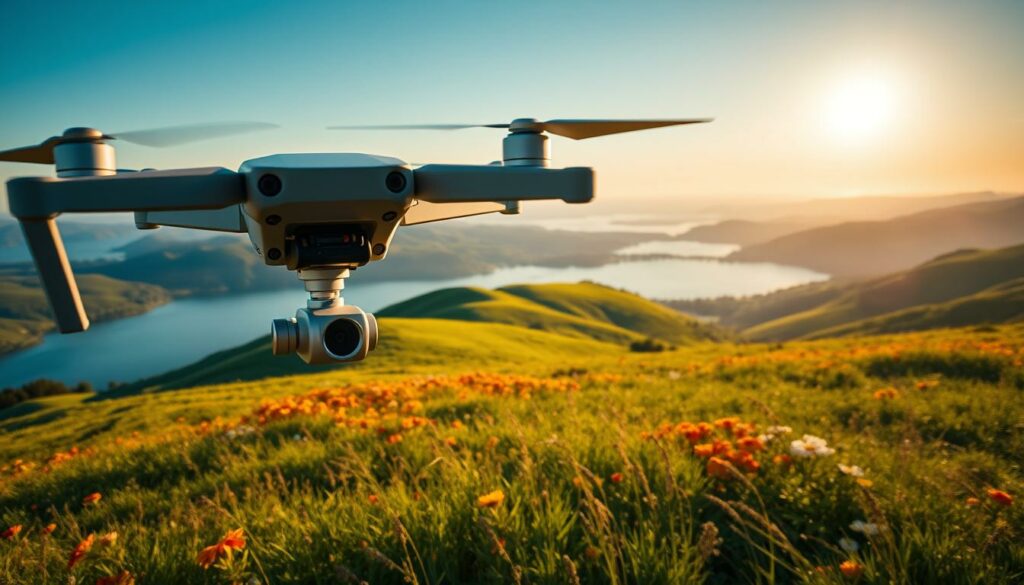
The single most crucial tip is operating your control sticks with small, gentle movements. Avoid abrupt changes in direction or speed that even the best equipment cannot fully compensate for.
Smooth Stick Movements and Flight Path Planning
I recommend flying in Cine Mode or Tripod Mode, which significantly reduces maximum speed. This makes it much easier to execute slow, controlled movements for cinematic results.
Keep your flight paths simple and fluid during each shot. Stick to one primary movement like flying straight forward rather than introducing multiple erratic direction changes.
Utilise cruise control features to maintain consistent movement patterns. This helps create that buttery-smooth motion professional videographers strive for.
Optimising Gimbal Settings for Cinematic Shots
Start by lowering your Pitch Speed setting to between 5 and 10. This makes your camera respond more slowly, creating beautifully cinematic pan and tilt shots.
Adjust the Pitch Smoothness (or “Stop Slowly” setting) to a higher value. This allows your camera to coast to a gentler, more natural stop after you release the joystick.
I suggest reducing your Yaw Endpoint to around 70-80% to limit maximum turning speed. This makes your aircraft’s turns appear smoother and more controlled in your final videos.
| Flight Mode | Maximum Speed | Control Responsiveness | Best For |
|---|---|---|---|
| Normal Mode | Full speed | Standard response | General flying |
| Sport Mode | Maximum speed | Very responsive | Fast action |
| Cine/Tripod Mode | Reduced speed | Slowed response | Smooth filming |
Shoot at higher frame rates such as 60fps for smoother slow-motion effects. This provides greater flexibility if you need minor post-production corrections.
Remember that post-production tools should only handle small refinements. Your piloting technique and equipment settings must do the heavy lifting for truly professional imaging.
Factors Impacting Stabilisation Performance
The performance of your stabilisation system isn’t just about the technology itself—it’s influenced by multiple variables during flight. Even the best equipment has limitations that can affect your final results.
Understanding these factors helps you work within your system’s capabilities. This knowledge ensures you capture the smooth footage you’re aiming for.
Environmental Conditions and Aircraft Movements
Strong wind and turbulent conditions challenge any stabilisation setup. Your aircraft must tilt and shake to maintain position, putting extra strain on the motors.
Aggressive flight patterns introduce additional vibrations that can overwhelm the compensation capabilities. High-speed manoeuvres particularly test the system’s limits.
Payload weight and balance are absolutely critical for optimal performance. Exceeding the rated capacity compromises both stability and overall flight characteristics.
Proper camera balance within the mounting system prevents uneven stress on the components. An unbalanced setup leads to inconsistent results and premature wear.
Calibration settings dramatically impact how natural your camera movements appear. Incorrect configurations can create jerky footage even with perfect hardware.
Physical damage or obstructions will prevent proper function. Always check for issues before takeoff to avoid tilting or complete instability.
Heavier three-axis systems offer superior performance but reduce your battery life. You’ll need to plan for shorter flight times with these advanced setups.
| Factor Type | Impact Level | Recommended Solution |
|---|---|---|
| Wind Conditions | High | Avoid flying in strong gusts |
| Flight Speed | Medium-High | Use slower, smoother movements |
| Payload Weight | Critical | Stay within rated capacity |
| System Balance | High | Ensure proper camera mounting |
| Battery Life | Medium | Plan for shorter missions |
Choosing the Right Gimbal for Your Drone
Selecting the perfect camera support for your aircraft involves more than just picking the most expensive option. I want to guide you through the key considerations to ensure a perfect match for your filming needs.
First, confirm your model supports an external camera mount. Major brands like DJI and Parrot often have integrated systems or exclusive accessory lines.
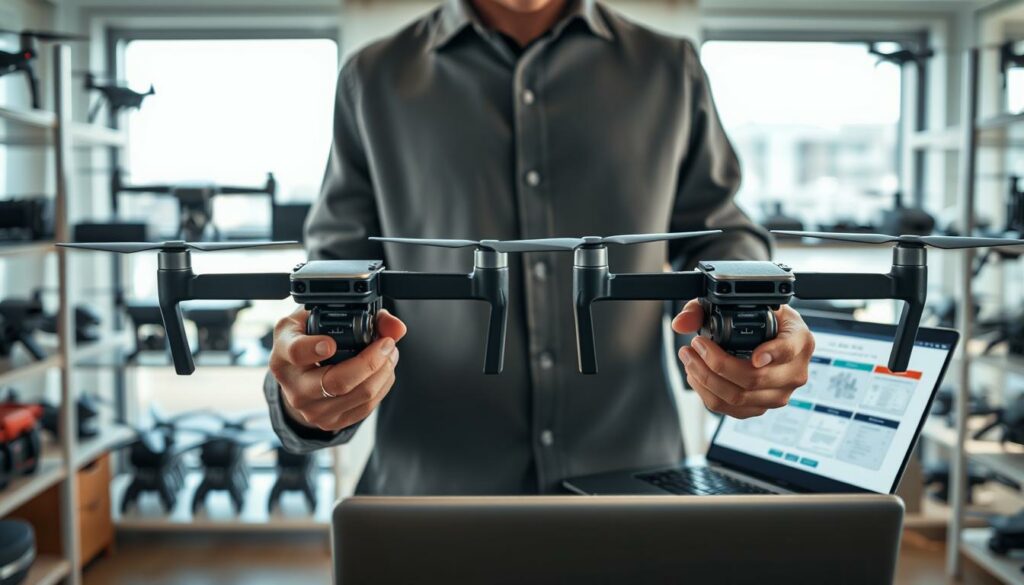
Purchasing through your aircraft’s manufacturer offers significant benefits. You receive dedicated support, proper documentation, and a device engineered for optimal performance.
Evaluating Payload, Integration and Compatibility
The number of axes is a critical decision. Two-axis units are lighter and cheaper but don’t handle yaw movements. Three-axis systems provide superior smoothness at a higher cost and weight.
Always check the rated payload capacity. Your support must handle your camera’s weight safely. Exceeding this limit risks poor performance and flight safety.
Compatibility is essential. Many mounts are designed for specific cameras, with GoPro being a common standard. Ensure your particular model is supported.
Look for units with remote control integration. This allows you to adjust the camera tilt directly from your flight controller for live framing.
Pre-Calibration and Ease of Use
Pre-calibrated gimbals offer true plug-and-play functionality. Whilst manual calibration isn’t difficult, it’s an extra step that can delay your first flight.
For sourcing, consider specialist retailers like Helipal.com, photography stores such as B&H, or general marketplaces like Amazon to compare prices and reviews.
| Feature | 2-Axis Gimbal | 3-Axis Gimbal | Best For |
|---|---|---|---|
| Weight | Lighter | Heavier | Portability-focused pilots |
| Cost | Less expensive | More expensive | Budget-conscious users |
| Yaw Compensation | No | Yes | Professional smoothness |
| Ease of Setup | Often simpler | May require more setup | Beginners seeking simplicity |
Advanced Drone Gimbal Stabilization Technologies
Beyond traditional three-axis compensation, modern systems now integrate spatial positioning control for unprecedented smoothness. I’m excited to share how these innovations are revolutionising aerial filming.
Recent Innovations in Gimbal Technology
The HOVERAir series introduces a unique motion control system. This technology ensures stability across rotational axes and XYZ spatial positioning.
During complex movements like quick side flight with ascent, the system precisely adjusts speed and position changes. This prevents jerks from sudden direction shifts.
Enhanced Motion Control Systems and Future Trends
These advanced systems coordinate entire movement patterns for seamless results. They represent the next generation of imaging technology.
Future trends include lighter materials and AI-powered tracking. These innovations expand applications into scientific imaging and industrial inspection.
| Feature | Traditional Systems | Advanced Technology | Benefit |
|---|---|---|---|
| Movement Control | Rotational axes only | Full spatial positioning | Complete trajectory management |
| Response Time | Reactive adjustments | Predictive coordination | Smoother transitions |
| Application Range | Standard videography | Specialised imaging | Broader professional use |
| Image Quality | Good stability | Unparalleled smoothness | Cinematic results |
This convergence of mechanical precision and intelligent control offers professional-quality view that was impossible just years ago. The technology continues to evolve rapidly.
Conclusion
The journey through camera stabilisation technology reveals one undeniable truth: proper camera support transforms aerial work from amateur to professional. Whether you choose mechanical systems, digital methods, or hybrid approaches, the right technology makes all the difference in your final results.
Using any stabilisation device is vastly superior to flying without support. Even basic systems dramatically reduce vibrations and keep your camera steady during flight. This eliminates distracting jitters and shakes that compromise image quality.
For critical applications like mapping and inspections, stable imaging ensures reliable data capture. The technology also provides creative freedom, letting you control angles without adjusting your aircraft’s entire position.
Remember that your piloting technique and settings configuration work alongside the hardware. As this technology advances with intelligent features, the possibilities for professional photography continue to expand beautifully.
FAQ
What’s the main difference between a mechanical gimbal and digital stabilisation?
I find that a mechanical device uses physical motors to counteract movement, keeping the camera steady. Digital methods use software to crop the image and smooth out shakes in post-processing. The former offers superior performance for professional videography.
Can I get smooth footage without a 3-axis gimbal?
You can, but it’s trickier. Digital techniques help, but they often reduce the final resolution. For truly cinematic shots, especially in windy conditions, I believe a proper mechanical system is essential for maintaining image quality.
How do I know if my camera payload is too heavy for a gimbal?
Always check the manufacturer’s specifications for maximum weight. An overloaded unit will struggle, affecting flight time and the motors’ ability to provide smooth control. It’s a balance between your equipment and the device’s capabilities.
Do I need to calibrate my gimbal before every flight?
A> I highly recommend it for optimal performance. A quick calibration ensures the sensors and motors are correctly aligned, which is crucial for keeping the horizon level during complex movements like yaw or pitch.
How does wind affect stabilisation systems?
Wind is a major challenge. A robust 3-axis unit will work hard to compensate for gusts, but very strong winds can still cause slight motion. Digital options might struggle more, as they have less real data to work with, impacting the final video.
Are there new technologies improving aerial photography stabilisation?
Absolutely! Recent innovations include enhanced motion control systems that use better algorithms for predictive movements. These advancements are making devices smarter and more capable of handling difficult flight paths for incredible imaging results.