
What if you could capture athletic performances from angles that make viewers feel like they’re flying alongside the athlete? That’s the power modern aerial technology brings to extreme sports cinematography.
I’ve spent years documenting everything from surfers carving waves to mountain bikers tackling treacherous trails. The evolution from ground-based filming to aerial perspectives has completely transformed how we experience these adrenaline-fuelled moments.
Choosing the right equipment makes all the difference between capturing breathtaking footage and missing the crucial shot. This guide draws from my personal experience to help you select the perfect flying camera for high-speed scenarios.
Whether you’re starting your filming journey or are an experienced pilot looking to upgrade, you’ll find practical advice here. We’ll explore technical specifications, real-world performance, and filming techniques specifically for dynamic environments.
My passion lies in using these incredible machines to document feats that were once impossible to film properly. Let’s dive into how you can achieve spectacular results with your next project.
Key Takeaways
- Aerial perspectives have revolutionised how we capture high-energy athletic performances.
- Selecting appropriate equipment is crucial for filming fast-moving subjects successfully.
- This guide caters to both beginners and experienced operators seeking improvement.
- Technical specifications like camera quality and flight stability significantly impact results.
- Practical filming techniques tailored to dynamic environments produce the best footage.
- Safety considerations remain paramount when operating in challenging locations.
- Personal experience informs recommendations for various budgets and skill levels.
Overview of Extreme Sports Drone Videography
There’s a special thrill in learning to position a flying camera precisely where the most dramatic athletic moments unfold. My journey into this world began with experimenting on local skateparks, gradually building the skills needed to track fast-moving subjects effectively.
My journey into aerial filming
I started with basic models, learning through trial and error. The initial learning curve was steep, but each flight taught me valuable lessons about camera positioning and movement prediction.
Understanding both the technology and the sports themselves became essential. This dual knowledge helps pilots anticipate where the action will happen next.
Why extreme sports demand specialised drones
Standard equipment often struggles with the demands of high-speed environments. Unpredictable movements and challenging conditions require robust construction and advanced tracking capabilities.
Modern flying cameras have evolved significantly to meet these needs. They maintain stable footage while keeping pace with athletes, even in demanding scenarios like water sports or mountain trails.
This specialised approach transforms how we capture these incredible performances. It creates immersive perspectives that ground-based filming cannot achieve.
Benefits of Using Drones in Action Sports
The true magic of aerial filming reveals itself when you can move with athletes in ways that ground-based cameras simply cannot match. This technology transforms how we capture high-energy performances.
Enhanced mobility and unique perspectives
Modern flying cameras offer unprecedented freedom of movement. They can follow subjects through challenging environments while maintaining stable footage.
Advanced tracking systems allow these devices to autonomously follow athletes. This lets me focus on creative framing rather than constant flight adjustments.
The creative possibilities are extraordinary. From dramatic reveal shots to intimate follow sequences, aerial perspectives add cinematic quality.
Practical advantages include quick deployment and minimal crew requirements. Capturing multiple takes becomes efficient without heavy equipment logistics.
This technology democratises professional-quality filming. Independent creators can achieve results that once required massive production budgets.
Safety benefits are significant too. These devices can film from positions that would be dangerous for human operators.
Essential Features of a Drone for Action Sports
In my experience documenting dynamic performances, certain equipment capabilities separate successful footage from disappointing results. Two aspects consistently prove critical when working with fast-moving subjects.
Battery Performance and Extended Operation
Sufficient power duration is absolutely essential. Athletes often require multiple attempts, and extended operation prevents missing crucial moments during battery swaps.
Manufacturer specifications represent ideal conditions. Real-world performance typically falls 15-20% short in windy conditions or when using intensive tracking modes.
Advanced Safety Sensing Systems
Comprehensive protection systems are non-negotiable for high-speed environments. These features provide essential safety when flying near trees, rocks, and other hazards.
Different technologies offer varying approaches. Omnidirectional sensing from multiple directions significantly reduces collision risks during dynamic filming situations.
| Model | Flight Time | Obstacle Sensing | Weight |
|---|---|---|---|
| DJI Mini 3 Pro | 34 minutes | Forward/Backward/Downward | 249g |
| DJI Air 3 | 46 minutes | Omnidirectional | 720g |
| Skydio 2+ | 27 minutes | Trinocular AI | 775g |
| Autel Evo II Pro | 34 minutes | 360-degree | 1197g |
Key Technical Specifications for High-Performance Drones
Technical specifications can feel overwhelming, but understanding just two key areas will dramatically improve your aerial filming results. The camera quality and flight capabilities determine whether you capture blurry disappointments or crisp, professional footage.
Camera quality and sensor performance
I consider the imaging system the heart of any filming setup. Larger sensors like the 4/3 CMOS in the Mavic 3 Classic capture significantly more light than smaller alternatives.
This translates to superior performance in variable conditions. You’ll notice better colour accuracy and reduced noise when filming during golden hour or in shaded areas.
Higher resolutions provide crucial editing flexibility. The Autel Evo II Pro’s 6K capability allows for stabilisation and cropping while maintaining 4K output quality.
Flight speed and stability
Your equipment must match the pace of athletic performances. Models achieving higher speeds can track subjects moving quickly through challenging terrain.
Stability remains equally important. Advanced gimbal systems work with flight controllers to deliver smooth footage even in windy conditions.
Finding the right balance between these specifications ensures you capture the excitement without technical limitations holding you back.
Best Compact Drones for Travel and On-the-Go Filming
When you’re trekking to remote filming locations, every gram in your backpack matters significantly. Compact models offer the perfect balance of performance and portability for filmmakers on the move.
Lightweight models like the DJI Mini 3 Pro
The DJI Mini 3 Pro stands out with its remarkable 249g weight. This keeps it under regulatory thresholds in many countries, eliminating registration requirements.
Despite its compact size, this mini pro model delivers professional 4K HDR footage. The 1/1.3-inch CMOS sensor with dual native ISO ensures excellent image quality in varying light conditions.
With up to 34 minutes of flight time, you can capture multiple athletic attempts without constant battery swaps. The Tri-Directional Obstacle Sensing makes it accessible for less experienced pilots.
Compared to alternatives like the DJI Mini 5 Pro or Autel Evo Nano+, each compact drone offers unique advantages. The trade-off is some wind resistance compared to larger professional drones.
For optimal results with these lightweight camera platforms, choose calm weather conditions. Their smaller size requires technique adjustments, but the portability payoff is substantial.
Mid-Range Options: Balancing Features and Portability
Mid-range aerial platforms offer filmmakers an incredible sweet spot that delivers impressive results without breaking the bank. These systems bridge the gap between entry-level equipment and professional gear perfectly.
Insights on models such as the DJI Air 3
The DJI Air 3 represents this category beautifully. Its 720g weight provides excellent stability in windy conditions while remaining portable. This model delivers up to 46 minutes of flight time.
Six-direction obstacle sensing protects the equipment during dynamic filming. The dual camera system combines wide-angle and 3x telephoto lenses creatively.
For around $1,000, you get professional features without premium costs. The DJI Air 3S offers a 1-inch sensor upgrade for better low-light performance.
These drones suit serious enthusiasts and semi-professionals ideally. They capture stunning content for social media or sponsorship portfolios effectively.
The range of capabilities makes them versatile tools. While they lack Hasselblad cameras, their value proposition remains strong.
Professional Drones for Premier Videography
The leap from consumer to professional equipment represents a significant milestone in any aerial filmmaker’s journey. When your projects demand cinema-quality results, premium platforms become essential tools rather than optional luxuries.
Triple camera systems and high resolution
I’ve found the DJI Mavic 3 Pro and Mavic 4 Pro particularly transformative. Their revolutionary triple-camera systems provide unprecedented versatility with wide-angle, medium telephoto, and long telephoto lenses in one aircraft.
The Hasselblad main camera with 4/3 CMOS sensor delivers professional imagery that rivals dedicated cinema equipment. Colour accuracy and dynamic range are exceptional, even in challenging lighting conditions.
For those seeking outstanding value, the Mavic 3 Classic offers the same Hasselblad quality without the triple-camera premium. It’s perfect for filmmakers who primarily need that stunning wide-angle perspective.
Extended flight times of 43-51 minutes combined with superior wind resistance make these platforms ideal for demanding shoots. The investment is substantial, but the creative possibilities justify the cost for serious professionals.
Drone Safety and Regulatory Considerations
Before your equipment even leaves the ground, understanding aviation regulations becomes your most important pre-flight checklist. Legal compliance ensures your creative work proceeds without interruptions or penalties.
I’ve learned that proper documentation separates professional operations from recreational flying. The UK requires both an Operator ID and Flyer ID for legal operation.
Understanding UK drone laws and licensing
My team holds A2 Certificate of Competency certification, which allows closer proximity to individuals. This qualification demonstrates advanced piloting skills and safety knowledge.
European classifications categorise equipment by weight. C0 models under 250g have fewer restrictions, while C1 and C2 categories require greater distances from people.
Maintaining visual line of sight remains fundamental for safety. This affects filming when athletes move behind obstacles or through complex terrain.
Altitude restrictions typically cap flights at 400 feet to protect manned aircraft. Insurance coverage is essential for professional pilots operating commercially.
Remote ID requirements will soon mandate broadcast capability for all drones. Staying informed about regulatory changes ensures long-term compliance.
Overcoming Challenges in Extreme Sports Filming
Successfully capturing extreme sports means embracing uncertainty as part of the creative process. The environment constantly tests both equipment and operator skills in unexpected ways.
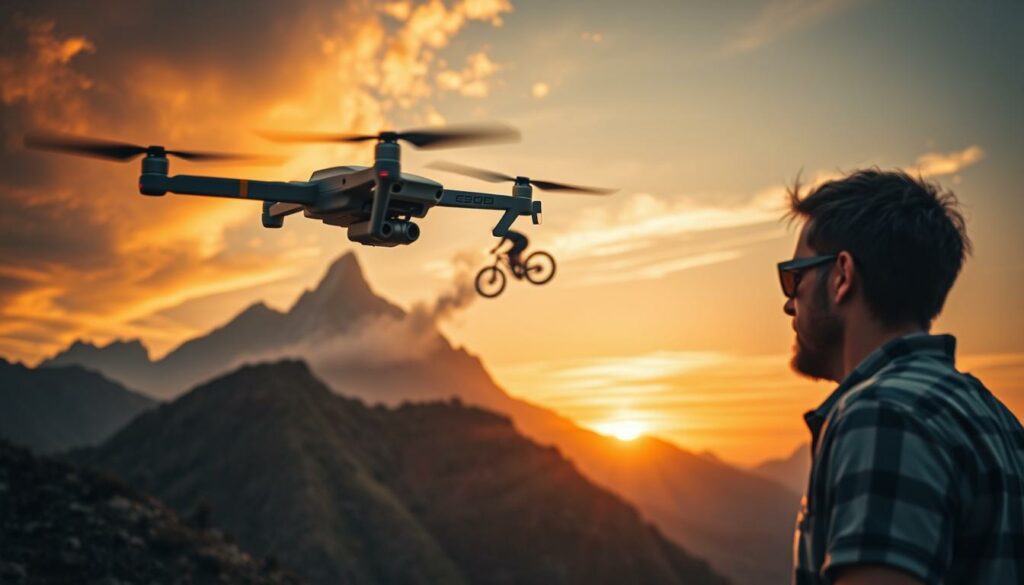
Weather presents the most immediate challenge. Wind gusts can destabilise your aircraft, while rain requires waterproofing considerations. Changing light conditions affect camera settings throughout the day.
Managing unpredictable conditions
Even advanced tracking systems struggle with sudden athlete direction changes. I’ve lost subjects behind obstacles when relying solely on automated features.
Understanding the sport helps anticipate movements. Knowing typical routes allows better positioning before action unfolds.
Environmental factors like water spray confuse sensors. Dust from mountain biking can damage equipment without proper maintenance.
Always have backup plans for equipment failures. Extra batteries and memory cards prevent missed opportunities when conditions change rapidly.
My experience taught me that practice builds essential problem-solving skills. Each challenging session improves your ability to adapt during critical filming moments.
The Importance of Battery Life and Flight Time
Nothing halts a filming session faster than a dying battery just as an athlete nails their trick. That moment is lost forever. This makes understanding and managing your equipment’s power absolutely essential for capturing consistent results.
Manufacturers advertise impressive figures, like 46 or even 51 minutes. However, these tests occur in perfect, windless conditions with minimal movement. Real-world use is far more demanding.
Real-world performance versus specifications
In my experience, you should expect a 15-20% reduction from the advertised flight time. An aircraft rated for 46 minutes might realistically give you 37-40 minutes of usable filming.
Several factors drain power quickly. Wind resistance forces motors to work harder. Active tracking modes require constant acceleration. Even cold temperatures reduce a battery’s chemical efficiency.
My strategy involves carrying multiple fully charged batteries. I rotate them to keep them at optimal temperature. Understanding your equipment’s return-to-home triggers is also crucial for safety.
While budget models may claim extraordinary battery life, like 75 minutes, approach these figures with scepticism. Professional models from brands like DJI offer more reliable performance that matches athletic pacing.
Always maintain a safe power reserve for your return journey, especially against a headwind. Pushing a battery to its absolute limit risks a catastrophic failure mid-flight.
Evaluating Drone Camera Systems for Action Sports
Your footage’s visual impact hinges directly on the imaging technology you select. I’ve found that understanding camera specifications is the key to capturing truly spectacular motion sequences.
The right combination of sensor, resolution, and frame rate turns chaotic movement into cinematic art.
Comparing 4K, HDR, and slow-motion capabilities
Sensor size dramatically affects image quality. Larger sensors like the 4/3 CMOS in Mavic models capture more light and detail than smaller alternatives.
This becomes crucial when filming in variable lighting conditions. You’ll notice superior dynamic range and reduced noise.
Higher resolutions provide incredible editing flexibility. The Autel Evo II Pro’s 6K capability allows for stabilisation and cropping while maintaining 4K output quality.
HDR recording preserves detail in both bright skies and shadowed terrain. This technology proves invaluable for outdoor filming scenarios.
Frame rates determine how you can showcase athletic technique. While 60fps delivers smooth motion, 120fps creates dramatic half-speed sequences.
The DJI Mini 5 Pro’s 240fps capability enables ultra-slow-motion that emphasises every movement with stunning clarity.
Colour profiles like D-Cinelike preserve maximum information for grading. These flat profiles require post-processing but deliver professional results.
Multi-camera systems offer instant focal length versatility. The Mavic Pro’s triple cameras eliminate repositioning time during critical moments.
| Model | Sensor Size | Max Video Resolution | Max Frame Rate | Colour Profile |
|---|---|---|---|---|
| DJI Mini 3 Pro | 1/1.3-inch CMOS | 4K HDR | 1080p/120fps | D-Cinelike |
| DJI Air 3 | Dual 1/1.3-inch CMOS | 4K/60fps HDR | 4K/60fps | D-Log M |
| DJI Mavic 3 Pro | 4/3 CMOS + Two Sensors | 4K/60fps HDR | 4K/60fps | D-Log |
| Autel Evo II Pro | 1-inch CMOS | 6K HDR | 6K/30fps | Log |
| DJI Mini 5 Pro | 1-inch CMOS | 4K/120fps | HD/240fps | D-Log M |
Choosing your equipment involves balancing these specifications against your specific needs. Not every project requires premium features, but understanding them ensures you make informed decisions.
Personal Experiences and Lessons Learned
Every crash, missed shot, and equipment failure has taught me more about aerial filming than any manual could ever explain. My journey from tentative beginner to confident operator was built on hundreds of hours of hands-on learning.

What I have discovered through practice
Starting with basic models gave me essential foundation skills. I learned through trial and error rather than jumping straight into complex equipment. This gradual progression proved invaluable.
Understanding both the technology and the athletic performances became crucial. Technical flying skills alone weren’t enough without knowing how competitors move and what moments to anticipate.
Environmental awareness developed through challenging conditions. Wind, lighting changes, and difficult terrain taught me to assess situations more accurately before launching.
Advanced safety features like obstacle avoidance saved my equipment multiple times. These technologies aren’t luxuries but essential protections during dynamic filming scenarios.
Battery management evolved from early mistakes. Running out of power at critical moments taught me conservative estimates and always maintaining reserve capacity.
Each session continues to provide learning opportunities. The relationship between consistent practice and growing confidence remains fundamental for all operators.
Expert Tips for Capturing Thrilling Aerial Footage
Transforming raw athletic energy into compelling visual stories requires more than just technical proficiency with your equipment. The magic happens when creative vision meets practical execution.
I’ve discovered that thoughtful planning separates ordinary recordings from extraordinary cinematic sequences. Let me share approaches that consistently deliver stunning results.
Choosing the right angles and shots
Different perspectives serve distinct storytelling purposes. Low chase angles emphasise speed and intensity, while high reveal shots showcase the environment’s scale.
I often vary altitude and distance throughout a session. This provides editorial flexibility during post-production.
Anticipating movement patterns helps maintain perfect framing. Intelligent tracking modes assist but shouldn’t replace active piloting.
Optimising lighting and weather conditions
Golden hour delivers beautiful warm tones and long shadows. Overcast conditions offer soft, even lighting that’s forgiving for exposure.
I schedule filming around optimal light whenever possible. Harsh midday sun creates challenging contrast that’s difficult to manage.
Communication with athletes ensures everyone understands the planned sequences. Safety remains paramount regardless of conditions.
Shooting with colour grading in mind provides greater flexibility later. These considerations elevate your final product significantly.
Comparing Popular Drone Models and Their Features
Choosing between the many aerial platforms available today can feel overwhelming. Understanding their key differences makes the decision much clearer for your specific filming needs.
Let’s break down the main contenders. I’ll focus on how their features and performance stack up against each other.
DJI versus alternatives like Skydio and Autel
DJI’s lineup is extensive. The DJI Mini series, including the Mini 3 Pro and Mini 5 Pro, offers superb portability.
Their sub-250g weight is a significant advantage for travel. The Mini Pro models pack impressive sensors into a tiny frame.
Stepping up, the DJI Air 3 and Air 3S provide a fantastic balance. They offer longer flight times and more advanced camera systems.
For professional work, the Mavic Pro line is unmatched. The DJI Mavic 3 Pro and Mavic 4 Pro deliver cinema-grade quality.
Alternatives like Skydio excel in autonomous flight. Their AI technology is brilliant for complex tracking shots.
Autel models, such as the Evo II Pro, compete with high-resolution sensors. They are strong options for pilots seeking top-tier image quality.
Each model has its strengths. Your choice ultimately depends on your budget and the specific shots you want to capture.
| Model | Weight | Max Flight Time | Key Camera Feature | Approx. Price |
|---|---|---|---|---|
| DJI Mini 3 Pro | 249g | 34 minutes | 4K HDR | £749+ |
| DJI Air 3 | 720g | 46 minutes | Dual Cameras | £1000 |
| DJI Mavic 3 Pro | 968g | 43 minutes | Triple Camera System | Premium |
| Skydio 2+ | 790g | 27 minutes | AI Tracking | Competitive |
| Autel Evo II Pro | 1191g | 34 minutes | 6K HDR | Higher |
Navigating Obstacles with Advanced Sensor Technologies
Modern safety technologies have transformed how we approach complex filming environments. What once required constant vigilance now benefits from intelligent assistance that anticipates hazards before they become problems.
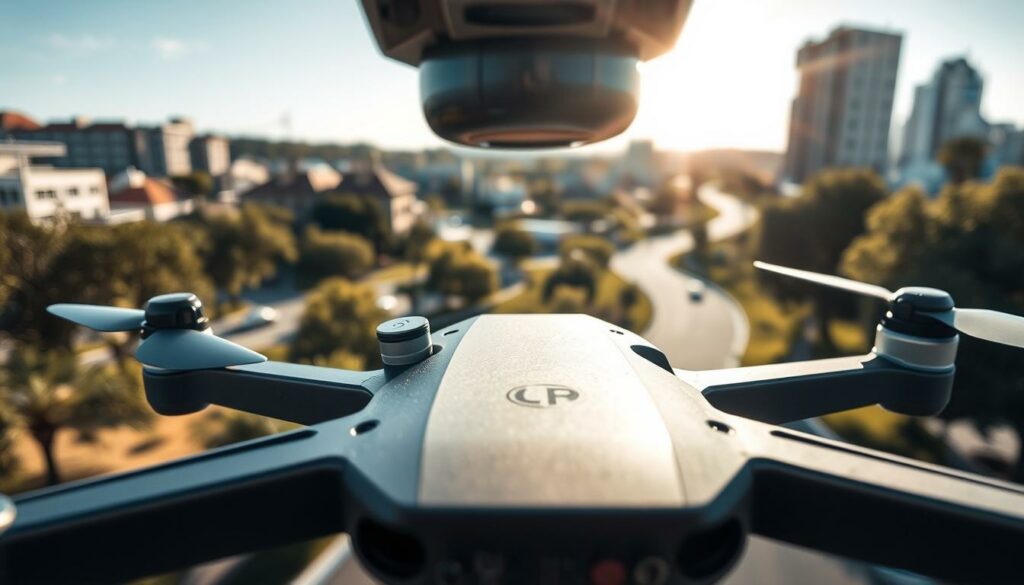
Different models offer varying levels of protection. Entry-level equipment might feature basic forward-only sensors, while premium systems provide comprehensive omnidirectional coverage.
How obstacle detection enhances safety
The DJI Air 3’s six-direction sensing represents a significant advancement. It protects from all angles including above and below during dynamic flight.
Specific technologies serve different purposes. Visual sensors detect visible obstacles, while ultrasonic systems work at close range. Infrared and LiDAR technologies excel in low-light conditions.
Skydio’s AI-powered approach differs from traditional methods. Their trinocular sensing enables remarkable autonomous navigation through challenging environments.
These systems provide crucial protection when focusing on subject tracking. They prevent interruptions that could damage expensive equipment during critical filming moments.
However, limitations exist. Thin branches and transparent surfaces can challenge even advanced obstacle avoidance systems. Bright sunlight and reflective materials may affect performance.
For beginners, these features accelerate learning by preventing early crashes. The Autel Evo Nano+ stands out as the only sub-250g drone with advanced avoidance technology.
Effective use requires understanding both capabilities and limitations. Treat these systems as helpful assistants rather than replacements for good judgment and attentive piloting.
Budget-Friendly Choices for Aspiring Pilots
Entering the world of aerial filming doesn’t require a massive initial investment. Several excellent budget options exist for beginners wanting to learn without financial stress.
These affordable drones typically cost under £300. They allow you to develop fundamental skills before upgrading to premium equipment.
Entry-level models like Holy Stone HS175D and Bwine F7
The Holy Stone HS175D stands out with its impressive 46-minute flight time. Weighing just 215g, this lightweight model offers 4K video and basic GPS features.
Meanwhile, the Bwine F7 claims an extraordinary 75-minute flight duration. While real-world performance may vary, it provides great value for beginners.
DJI’s Mini 4K represents the best budget choice for quality-conscious newcomers. Priced around £300, it delivers reliable performance with decent 4K footage.
The Potensic Atom 2 offers competitive features at similar price points. It demonstrates how newer manufacturers create viable alternatives.
Key limitations to expect include:
- Basic camera systems without advanced stabilisation
- Limited wind resistance in challenging conditions
- Absence of obstacle avoidance technology
- Simpler controller interfaces than premium models
These entry-level drones serve as perfect stepping stones. They help you understand which premium features justify future investment.
Conclusion
Finding the perfect aerial filming companion is about matching your ambitions with the right technological partner. Your ideal choice balances camera quality, flight performance, and safety features with your specific needs and budget.
Remember that practice develops skills no equipment can replace. Even the most advanced drone requires competent operation to capture spectacular footage consistently.
Stay informed about evolving regulations and manufacturer landscapes. Responsible piloting ensures everyone’s safety while protecting access to these incredible filming tools.
Use this guide as your starting point for further research. Watch sample footage and test different models when possible to find your perfect match.
These remarkable flying cameras have truly revolutionised how we document athletic performances. They offer creative possibilities that continue to inspire filmmakers at every level.
FAQ
What is the most important feature to look for in a drone for filming fast-paced sports?
In my experience, battery life and flight time are absolutely critical. You need a model that can keep up with the action without constant landings to swap batteries. A long flight time ensures you capture the entire sequence.
How does obstacle avoidance technology help when filming in complex environments?
Advanced obstacle avoidance systems are a game-changer. They use multiple sensors to detect trees, buildings, and other hazards, allowing me to focus on the shot rather than worrying about a crash. This feature is vital for safety and creative freedom.
Is the DJI Mini 3 Pro a good choice for someone starting out in sports videography?
I think the DJI Mini 3 Pro is a fantastic budget-friendly option. It’s incredibly lightweight, has superb camera quality, and includes crucial features like obstacle sensing. It’s a brilliant starting point for new pilots.
What is the real-world difference in camera quality between a mid-range and a professional drone?
The difference is often in the sensor size and lenses. A model like the DJI Air 3 offers excellent 4K video, but a professional drone provides higher resolution, better low-light performance, and more colour data for advanced editing.
Are there any legal requirements I need to know about before flying in the UK?
Yes, absolutely. In the UK, you must follow the Civil Aviation Authority’s Drone Code. For most drones over 250g, you’ll need to register as an operator and pass an online theory test. Always check the latest rules before you fly.
Can you recommend a good drone with reliable subject tracking for solo filming?
Definitely. Both the DJI Mavic 3 and the Autel Robotics Evo Lite+ have impressive tracking capabilities. They can lock onto a moving subject, like a mountain biker, and follow them smoothly, which is incredibly helpful when you are filming alone.