
Have you ever watched a breathtaking aerial sequence and wondered how the operator achieved such fluid, cinematic movements? It often looks like pure magic. The truth is, that level of control comes from a deep understanding of the craft.
I remember my first attempts with a drone. The footage was shaky and unpredictable. Over time, I realised that mastering the controls is not just about technical skill. It is about learning how each joystick movement translates into a visual story.
This comprehensive guide is designed to share that journey. I will walk you through the essential steps, from your initial, nervous flight to executing professional-grade shots. My aim is to help you avoid the common pitfalls I encountered.
Whether you are completely new or looking to refine your skills, this article provides a clear roadmap. You will learn the techniques that transformed my own aerial videography. By the end, you will have the confidence to capture stunning footage from the sky.
Key Takeaways
- Fluid cinematic movements require practice and a deep understanding of your equipment’s capabilities.
- Transforming basic control skills into visual storytelling is the key to professional results.
- This guide offers a structured path from a beginner’s first flight to advanced shooting techniques.
- Avoiding common early mistakes can significantly fast-track your learning process.
- Mastering precise control is essential for capturing stable and compelling aerial footage.
- Specific settings and movement techniques will be shared to enhance your videography work.
- The goal is to develop both the technical precision and creative vision needed for cinematic shots.
Introduction to Drone Flight Controls and Cinematic Shots
When I first started operating these aerial devices in 2014, I never imagined how much technical skill would impact my creative results. The journey from basic hovering to executing smooth cinematic sequences has been incredibly rewarding.
My Journey from Beginner to Enthusiast
My personal experience with drones began almost a decade ago. Initially, my sessions were infrequent as I built confidence gradually. Over time, I increased my practice to multiple weekly flights.
I discovered that simply logging air time wasn’t enough after the initial learning phase. What truly accelerated my progress was deliberate practice of specific techniques rather than random manoeuvres.
Why Mastering Controls Elevates Filmmaking
Developing muscle memory for subtle joystick inputs transformed my approach. This allowed me to focus on composition and storytelling instead of basic navigation.
The connection between technical precision and creative vision became clear. Without control mastery, even stunning locations won’t translate into compelling footage. Consistent, focused practice combined with studying great examples has been key to my continuous improvement in aerial cinematography.
Getting Started with Drone Flying
The journey from novice to confident operator begins with mastering the fundamentals in a safe, controlled manner. I found that starting with the right approach prevented many early frustrations and built a solid foundation for more advanced techniques.
Embracing Beginner Mode and Basic Controls
When I first began to learn to fly, I immediately activated beginner mode on my equipment. This setting limits speed and distance while activating collision sensors, providing essential protection for your investment.
My initial practice focused on simple hovering at eye level. This gave me time to check vital indicators like signal strength and battery levels. From there, I progressed to basic forward movement, avoiding sudden, jerky motions.
The rotational control called yaw became my primary focus. Using my left thumb, I practised moving left and right slowly, imagining clock positions. Starting with gentle 10 and 2 o’clock movements, I gradually advanced to more extreme 9 and 3 positions.
| Practice Exercise | Skill Developed | Recommended Duration | Progression Goal |
|---|---|---|---|
| Eye-Level Hovering | Stability & Orientation | 5-10 minutes | Steady position for 30+ seconds |
| Clock Yaw Practice | Rotational Control | 15-20 minutes | Smooth 360° rotations both ways |
| Slow Forward Flight | Directional Precision | 10-15 minutes | Straight line without deviation |
The Importance of Consistent Practice
Regular practice sessions proved absolutely crucial for my development. I dedicated time specifically to improving my skills through focused exercises rather than random flying.
Finding a safe location like a private field allowed me to push beyond my comfort zone without risk to others. Flying at low heights through tight spaces significantly improved my dexterity and confidence.
The key lesson I learned is that slow, deliberate movements produce the classy cinematic results seen in professional work. Rushing the process only leads to shaky footage and missed opportunities.
Essential Drone Flying Tips for Videographers
Achieving that sought-after cinematic quality in my work required me to unlearn a common beginner’s habit. The instinct to move quickly is natural, but it’s the opposite of what creates beautiful, professional footage.
Overcoming Initial Challenges on the Flight Deck
One of the toughest skills to master is maintaining super slow, steady movements. It sounds simple, but applying constant, gentle pressure to the joysticks is genuinely challenging.
I found that developing this muscle memory took dedicated, conscious effort. The payoff, however, was immense. When I prioritised smooth, deliberate actions over speed, the quality of my shots improved dramatically.
Avoiding Common Mistakes for Smoother Footage
The most frequent error I see is flying too fast. This results in rushed-looking video that lacks polish. My top tips centre on slowing everything down.
Avoid jerky motions and sudden rotations, as these instantly mark your work as amateur. Instead, practice specific movements repeatedly. A great example is flying backwards, which offers a better perspective and avoids propeller shadows.
By concentrating on these fundamentals, I overcame early hurdles and started producing significantly smoother material. Patience with your drone is the key to cinematic results.
Understanding and Adjusting Camera Settings and ND Filters
Camera configuration was the missing piece that transformed my aerial work from amateur to cinematic. Understanding how light exposure affects your shots is crucial for professional results.
Manual Settings vs. Automatic Modes
I initially relied on automatic modes for convenience. However, I quickly discovered they create inconsistent drone footage. The camera constantly adjusts to lighting changes, causing abrupt shifts in your final frame.
Now I exclusively use manual settings for my aerial film work. This gives me complete creative control. Manual configuration ensures consistent exposure across all shots.
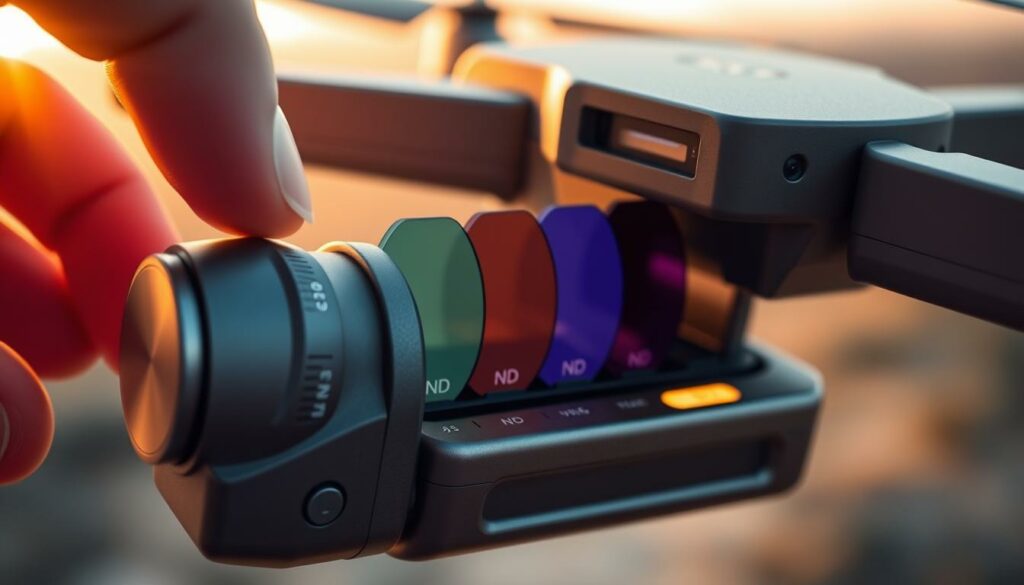
How ND Filters Transform Your Footage
When I focused mainly on photography, I didn’t understand ND filters’ importance. For aerial filming, they’re essential. Without them, your drone footage can stutter badly.
ND filters act like sunglasses for your camera lens. They limit light entering the camera, allowing slower shutter speeds. This prevents overexposure while maintaining smooth motion.
I follow the 180-degree shutter rule for cinematic results. For 24fps content, I use 1/50 shutter speed. Proper settings combined with ND filters have dramatically improved my film quality.
Mastering Flight Movements and Techniques
I discovered that fluid camera movements were the secret ingredient that transformed my aerial work from simple documentation to visual storytelling. The difference between basic footage and cinematic content lies in how the camera interacts with the environment.
Achieving Smooth Panning and Orbit Shots
Mastering smooth movements has been the single most important factor in improving my video quality. By smooth, I mean fluid and intentional rather than necessarily slow. Jerky or sudden rotations immediately diminish the professional quality of any shot.
A game-changing discovery for me was adjusting the control stick sensitivity on my controller. Tweaking the gimbal’s yaw smoothness and rotation speed transformed my ability to achieve cinematic movements. If you’ve never changed these settings from factory defaults, I highly recommend experimenting.
Panning shots are amongst my favourite techniques, but I initially struggled with stuttering footage. I learned that the closer you are to your subject, the slower you must pan to avoid choppy results. Increasing distance allows faster panning with less risk of stutter.
| Technique | Primary Movement | Skill Level | Key Benefit |
|---|---|---|---|
| Basic Pan | Horizontal camera movement | Beginner | Simple scene establishment |
| Orbit Shot | Circular around subject | Intermediate | Dynamic perspective changes |
| Rise & Rotate | Vertical with camera rotation | Advanced | Dramatic reveal effect |
| Compound Movement | Multiple axes simultaneously | Expert | Professional cinematic quality |
Learning to combine two or more movements into one shot has elevated my work significantly. The orbit shot, circling around a fixed subject while maintaining focus, requires delicate coordination but produces stunning results. Similarly, the birds-eye-view shot with downward gimbal creates dramatic reveals.
Planning Your Flight for Optimal Cinematic Shots
My most successful aerial filming sessions always begin long before I even power on my equipment. Thorough preparation transforms chaotic attempts into organised, productive shoots where every minute of battery life counts.
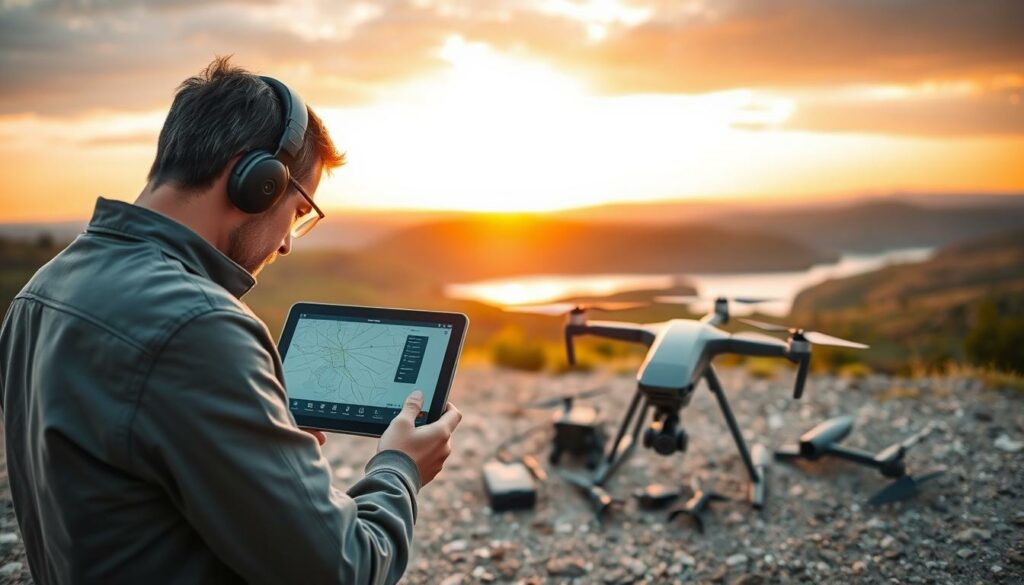
When heading to a new location, I research extensively using Google Maps. This saves precious battery power that would otherwise be wasted on exploratory flights. Knowing the terrain and sun position in advance helps me plan my shots efficiently.
I prefer filming at sunrise or sunset to capture golden hour light. Early morning offers calm conditions with minimal wind interference. Understanding the sun’s trajectory relative to my subject is crucial for optimal lighting.
Pre-Flight Checklists and Site Preparation
My pre-flight routine includes comprehensive weather checks. I look for precipitation below 10% and winds under 15 knots. Clear visibility and adequate cloud base height are essential for safe operations.
Site assessment involves identifying hazards like towers and power lines. I establish clear take-off zones and verify GPS signal strength. Visual inspection of my equipment ensures everything functions correctly before each flight.
Following these rules consistently has helped me maximise limited filming time. Proper planning turns challenging conditions into opportunities for stunning cinematic results.
Utilising Intelligent Flight Modes and Software Tools
What truly elevated my aerial work was learning to leverage the smart technology built into modern flight systems. While manual control remains essential, these intelligent features open up creative possibilities that would be extremely challenging to achieve manually.
Making the Most of DJI’s Intelligent Flight Modes
I regularly incorporate several smart modes into my workflow. Tripod or Cinematic Mode has become invaluable for achieving buttery-smooth movements. It slows everything down, making professional results much more accessible.
Course Lock is another favourite that sets controls relative to the aircraft’s current path. This allows me to maintain a set direction while tracking moving subjects. Point of Interest mode lets me circle around buildings or landmarks effortlessly.
Waypoints functionality and ActiveTrack have expanded my creative capabilities significantly. These tools free me to focus on camera work rather than piloting. Mastering when to use each mode has been transformative.
Understanding Return-to-Home and Safety Features
Return-to-Home (RTH) is a fantastic safety feature that requires proper understanding. It can trigger manually, from low battery, or lost connection. New pilots often encounter issues with this function.
My practice routine includes setting RTH points and programming appropriate altitudes. I always switch back to manual controls about 20-30 feet above my landing zone. Following safety rules and taking a systematic course in these features builds confidence.
Understanding how dynamic RTH works prevents potential accidents. This knowledge allows me to use intelligent modes effectively while maintaining awareness of risks.
Capturing Aerial Videography with Cinematic Flair
The most significant leap in my aerial work came when I shifted my focus from piloting to storytelling. True mastery in this field is less about complex manoeuvres and more about how each movement serves the narrative.
I’ve realised that the device itself is just a tool. Technical proficiency is the foundation, but thinking like a filmmaker is what creates compelling videography. This means planning your shots with intention.

Storytelling Through Dynamic Movements
Studying professional aerial drone sequences revealed a key insight. The most effective video often uses surprisingly simple camera work. A slight glide or a subtle tilt can be incredibly powerful when used with purpose.
The real artistry lies in creative decisions. Building suspense by delaying the reveal of your subject adds drama. Composing with layers in the foreground and background creates wonderful depth.
My approach now always starts with the story. I then select from a repertoire of essential movements that best convey the emotion or information.
| Cinematic Shot | Primary Movement | Storytelling Purpose |
|---|---|---|
| Forward Reveal | Fly forward, tilt gimbal down | Creates dramatic tension and discovery |
| The Dronie | Fly backward and upward | Ideal for stunning establishing shots |
| Orbit | Circle a fixed subject | Offers a dynamic, engaging perspective |
| Tracking Shot | Follow a moving subject | Adds energy and narrative flow |
Watching videos from skilled operators is fantastic for inspiration. The goal, however, is to absorb these techniques and then develop your own unique style. This is the way to create aerial content that truly stands out.
Adjusting Techniques for Weather and Environmental Conditions
My approach to capturing stunning footage now hinges as much on checking meteorological reports as it does on checking my equipment. Paying close attention to the weather conditions is a non-negotiable part of my pre-flight ritual. These environmental factors dramatically affect both safety and the final quality of my videography.
While modern drones are robust, wind has definite limits. Even a breeze of 10-15 mph can challenge the gimbal, resulting in wobbly footage. For the smoothest results, I avoid the windiest days entirely.
I’ve found that footage shot in acceptable weather conditions is so stable it rarely needs post-production stabilisation. Timing is also crucial. I actively avoid the harsh light of midday, which washes out colours.
My preferred time of day is sunrise, followed by sunset. A sky with some cloud cover provides beautiful texture. Extreme temperatures, hot or cold, also demand caution as they cause the battery to drain more quickly.
Moisture is a serious risk I never ignore. Rain, fog, or high humidity can damage sensitive electronics. In windier weather, I adjust my technique by reducing my flight speed and avoiding sharp turns. This understanding allows me to make smart decisions about when to fly, ensuring high-quality results every time.
Conclusion
What began as a technical challenge eventually became an artistic pursuit that completely changed how I see the world through a lens. The transition from basic pilot skills to creating meaningful aerial film work requires dedication and consistent practice.
This comprehensive guide has covered everything from fundamental controls to advanced cinematic techniques. Each flight session builds your confidence and refines your creative view. Remember that professional-looking video results from patience and understanding your equipment.
Whether your interest lies in aerial photography or dynamic videography, the principles remain the same. Invest time in mastering each technique, and don’t rush the process. The most rewarding drone work comes from combining technical precision with artistic vision.
Keep learning, stay curious, and enjoy every moment of your journey into aerial cinematography. The skills you develop will open up incredible creative possibilities for years to come.
FAQ
What is the best way for a beginner to learn how to fly a drone for video?
I always recommend starting in a wide-open space, like a park, and using the beginner mode on your aircraft. This mode limits the speed and range, giving you a safe environment to get a feel for the controls. Practising basic movements like hovering, and moving forward, backward, left, and right is the foundation for everything else.
How can I make my aerial footage look more cinematic and less jerky?
The secret is in your thumbs! I’ve learned that slow, deliberate movements on the control sticks are key. Also, don’t forget to adjust your gimbal settings for a smoother pan. Using ND filters helps maintain a proper shutter speed, which gives your video that fluid, professional motion blur we all love.
When should I use manual camera settings versus automatic modes?
I use automatic modes when I’m scouting a location or need to capture a shot quickly. But for true creative control, manual is the way to go. It allows me to lock in the exposure, ensuring my shots are consistent, especially when filming a sequence that will be edited together later.
What are some essential pre-flight checks I should do every time?
My routine is simple but vital. I always check the battery levels on both the drone and the controller, inspect the propellers for damage, ensure the SD card has enough space, and verify the GPS signal is strong. A quick check of the local weather conditions, especially wind speed, is also a must before takeoff.
How do intelligent flight modes, like those on a DJI model, help with filmmaking?
These modes are fantastic assistants! Features like ActiveTrack can follow a subject smoothly, allowing me to focus on framing the shot. Waypoint mode lets me plan a precise flight path for a repeatable cinematic move. They help execute complex shots that would be very difficult to do manually.
Is it safe to fly my camera drone in windy conditions?
It depends on your skill level and the aircraft’s capabilities. I avoid flying in strong winds, but a light breeze can be manageable. Always check the maximum wind speed resistance for your specific model. High winds can drain the battery faster and make it hard to get stable footage, so caution is key.