
Have you ever wondered why some aerial films look absolutely breathtaking while others appear dull and amateurish, despite using similar equipment?
I’ve spent years mastering aerial photography and want to share my complete configuration guide with you. Getting your filming equipment properly set up makes all the difference between mediocre results and professional-quality content.
Throughout my journey creating aerial content, I’ve discovered that the right adjustments transform ordinary footage into spectacular visual stories. This comprehensive walkthrough will take you step-by-step through the entire process.
You’ll learn not just what configurations to use, but why each choice matters for your final production. Whether you’re beginning your filming adventure or refining your technique, I’ll share practical insights that have revolutionised my own work.
My goal is to make technical configuration approachable and straightforward. You’ll spend less time fiddling with adjustments and more time creating amazing visual content that stands out on social platforms.
Key Takeaways
- Proper configuration transforms amateur footage into professional-looking results
- Understanding the ‘why’ behind each adjustment is crucial for mastery
- Step-by-step guidance ensures confidence in your equipment setup
- Practical insights save time and improve your filming technique
- The right adjustments make your content stand out on video platforms
- Technical configuration becomes approachable with clear explanations
- You’ll create spectacular visual stories that captivate your audience
Understanding the Importance of Drone Camera Settings
The gap between amateur and professional aerial content often comes down to one critical factor: proper equipment configuration. I’ve learned through extensive experience that even premium gear can produce disappointing results without the right adjustments.
Why Proper Configuration is Essential for Aerial Footage
Modern filming equipment comes with incredible capabilities, but these only shine through when optimised correctly. The relationship between different adjustments determines whether your visual content looks professional or amateurish.
I’ve discovered that understanding how each setting interacts creates harmonious results. This knowledge helps capture stunning imagery straight from your equipment.
| Common Issue | Configuration Cause | Professional Solution |
|---|---|---|
| Unwanted Banding | Incorrect shutter speed | Match frame rate doubling |
| Over/Underexposed Shots | Poor exposure balance | Manual exposure control |
| Unnatural Motion | Wrong stabilisation | Appropriate motion profile |
| Flat Colours | Auto colour profile | Custom colour grading |
Avoiding Common Drone Camera Issues in My Experience
Through hundreds of flights, I’ve encountered numerous problems that proper configuration eliminates. Banding in video, incorrect exposure, and unnatural motion blur are frequent issues I’ve learned to avoid.
My approach focuses on helping you understand the “why” behind each choice. This empowers you to make informed decisions based on your specific filming conditions and creative vision.
Quality aerial footage depends on configuring every aspect to work together seamlessly. The right adjustments transform ordinary shots into spectacular visual stories that captivate audiences.
Mastering drone camera settings youtube
The secret to smooth, professional-looking video lies in understanding how shutter speed, ISO, and exposure work together. I’ve found this balance to be the single most important skill for capturing stunning aerial footage.
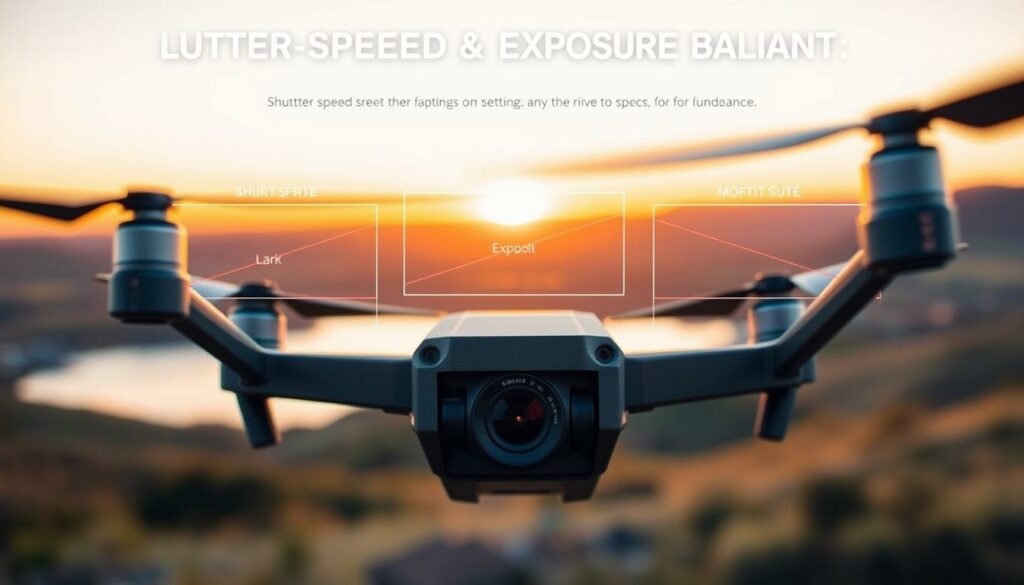
My fundamental rule involves setting the shutter speed to 1 over 2 times the frame rate. When filming at 30 frames per second, I maintain 1/60th of a second for natural motion blur. This formula creates that cinematic quality rather than choppy or unnaturally sharp results.
Balancing Shutter Speed, ISO, and Exposure for Smooth Video
I always begin in manual exposure mode with ISO at 100 and shutter locked at 1/60th of a second. If the image appears too dark, I gradually increase the ISO until achieving the desired brightness.
When the image becomes too bright, increasing the shutter speed beyond 1/60th risks introducing unwanted banding. This compromises that smooth, natural motion quality we strive for in professional footage.
How ND Filters Enhance Bright Lighting Conditions
Neutral density filters become essential in bright conditions. They function like sunglasses for your lens, reducing light entering the equipment.
Quality ND filters allow me to maintain that crucial 1/60th of a second shutter speed even in harsh midday sunlight. By controlling exposure through filters rather than adjusting shutter speed, I consistently achieve smooth results regardless of lighting.
The harmony between these three elements truly separates amateur aerial video from professional-quality content.
In-Depth Look at Video and Photo Configuration
Many creators focus solely on video adjustments, but I’ve found that optimising both moving and still image capture dramatically improves overall production quality. Each requires distinct approaches that I’ve refined through extensive testing.
Optimising Video Settings: Frame Rate, Resolution, and Format
For the best video quality, I consistently use 4K resolution at 3840 x 2160 with 30 frames per second. This video size provides maximum flexibility in post-production while looking stunning on modern displays.
I set the video format to .MP4 for its excellent quality and universal compatibility. When shooting in NTSC regions, 30fps becomes my standard frame rate for smooth motion.
White balance adjustments depend entirely on weather conditions. I choose sunny mode for bright days and cloudy for overcast conditions. For colour grading flexibility, D-Cinelike profile preserves highlight and shadow detail beautifully.
Editing Photo Settings for Stunning Aerial Imagery
My photo configuration uses single shot mode with 4:3 aspect ratio. I capture in RAW + JPG format, ensuring maximum editing flexibility while having quick-sharing backups.
I set white balance to auto and colour to D-Cinelike, knowing this only affects JPG files. RAW image files preserve all original sensor data, giving me complete creative control during editing.
These configurations work brilliantly across different equipment models. I always fine-tune based on specific shooting conditions and final delivery requirements.
Exporting Your Drone Footage for YouTube and Social Media
Many creators invest hours perfecting their aerial shots only to see quality diminish during the export process. I’ve learned that understanding bitrate is essential for maintaining your hard work’s visual integrity.
Understanding Bitrate and Export Options for YouTube
Bitrate represents the data amount encoding your visual and audio content. Higher values create better video quality but larger files. Lower values reduce file size but compromise detail.
For 4K videos, I export at 3840 x 2160 resolution with 60 Mbps target bitrate. I use VBR 2-pass encoding for best results. Profile High, Level 5.1 ensures excellent compression while maintaining overall quality.

I always select “Render at Maximum Depth” and “Use Maximum Render Quality” options. These choices produce noticeably better results despite slightly longer processing times.
Best Export Settings for Vimeo and Instagram
Vimeo guidelines mirror YouTube’s requirements, making my post-production workflow efficient. I maintain similar format and bitrate level for consistent quality.
Instagram requires different approaches. I export at 1080 x 1080 square format with 5 Mbps target bitrate. The platform heavily compresses content anyway, so extreme quality settings become unnecessary.
Through creating numerous tutorials, I’ve refined these export settings to deliver excellent results across platforms. The key is balancing what your equipment captures with what each platform displays effectively.
Conclusion
With the right knowledge and practice, transforming ordinary aerial shots into professional-grade imagery becomes an achievable goal for any enthusiast. I hope this comprehensive guide has given you the confidence to optimise your equipment and create stunning visual content.
The beauty of modern aerial photography is that once you’ve mastered the essential adjustments, they become second nature. This allows you to focus on composition and storytelling rather than technical details. Understanding how different parameters work together empowers you to capture professional-quality results in any conditions.
Remember that technical mastery serves your creative vision. I encourage you to experiment with various scenarios and develop your own preferences. Keep practising, and most importantly, keep flying—your next spectacular aerial capture is just one well-configured flight away.
FAQ
What is the most important aerial filming setting I should adjust first?
In my experience, getting the shutter speed right is the best starting point. I always aim for a value that’s double my frame rate. For example, if I’m filming at 25fps, I set my shutter to 1/50th of a second. This creates natural-looking motion blur, which is crucial for smooth, cinematic footage.
How do I prevent my videos from looking too shaky or jittery?
I’ve found that a high frame rate, like 50 or 60fps, can help with this. It gives you more data, which results in smoother playback. Also, using Neutral Density (ND) filters allows me to keep that ideal shutter speed even on bright days, which dramatically improves the overall stability and quality of the footage.
Which colour profile should I use for the best results in post-production?
I always shoot in a flat or log profile, such as D-Log on my DJI equipment. It captures more information in the shadows and highlights. This gives me much greater flexibility when colour grading later on, allowing me to achieve a richer, more professional look for my final video.
What’s the best resolution and format for uploading to YouTube?
For the highest quality, I film in 4K resolution. When exporting, I use a high bitrate H.264 MP4 file. This combination seems to work perfectly with YouTube’s compression and ensures my viewers see the sharpest image possible. Always check the platform’s latest recommended upload specifications for the best results.
Why does my white balance sometimes look wrong, and how can I fix it?
Leaving white balance on ‘Auto’ can cause colours to shift unexpectedly between shots. I manually set my white balance to match the lighting conditions—like ‘Sunny’ or ‘Cloudy’. This guarantees consistent colour from start to finish, making editing much easier and giving my imagery a more cohesive feel.
How can I improve the quality of my aerial photography?
For stills, I shoot in RAW format instead of JPEG. RAW files contain all the data from the sensor, which means I can adjust exposure and colour with far more control afterwards. It makes a huge difference in bringing out the finest details in my photographs.