
Can a piece of technology that’s nearly four years old still compete with the latest and greatest? That’s the crucial question we’re tackling in this deep dive. When it launched back in 2022, this particular model fundamentally changed what we expected from a lightweight, sub-250g aircraft.
Fast forward to today, and the market looks very different. Newer models boast impressive specs, but this older sibling has one massive advantage: its price. You can now find it for hundreds of pounds less than its original cost, with refurbished options offering even greater savings.
Having flown this machine extensively over the past few years, I can honestly say it’s my second most-used device for fun. Its enduring appeal is a testament to its solid design and capable performance. This analysis will break down whether it represents genuine value for your money in the current climate.
Key Takeaways
- The model in question, released in 2022, offers significant cost savings compared to its launch price.
- Despite its age, it remains a popular choice for recreational pilots due to its capable feature set.
- Refurbished units are available with a full one-year warranty, presenting excellent value.
- This evaluation will compare its camera, flight performance, and battery life against newer alternatives.
- The central question is whether saving money on this model is smarter than investing in the latest version.
- This guide aims to provide the detailed insight needed for a confident purchasing decision.
Overview of the DJI Mini 3 Pro
The progression of lightweight flying cameras tells a fascinating story of innovation meeting user demands. I’ve watched this particular line evolve from its humble beginnings to the capable machine we’re discussing today.
Historical Evolution of the Mini Series
When I think back to the first mini drones in this series, they were impressive for their size but limited in features. Enthusiasts quickly wanted more professional capabilities from these compact flyers.
The breakthrough came when the manufacturer listened carefully to customer feedback. They created a model that combined portability with features once reserved for larger, costlier aircraft.
Key Updates Since Its Release
Since its launch, this mini pro has received several firmware improvements. These updates have refined its performance and enhanced existing functions.
The most significant advantage remains its sub-250g weight classification. This means fewer restrictions in many countries compared to heavier drones.
What started as a capable machine has become even more polished over time. Regular software enhancements have kept it competitive against newer models entering the market.
Design, Build and Feature Highlights
When you first hold this compact flyer, the engineering brilliance becomes immediately apparent. The thoughtful design balances professional capabilities with remarkable portability, creating a machine that feels substantial yet incredibly lightweight.
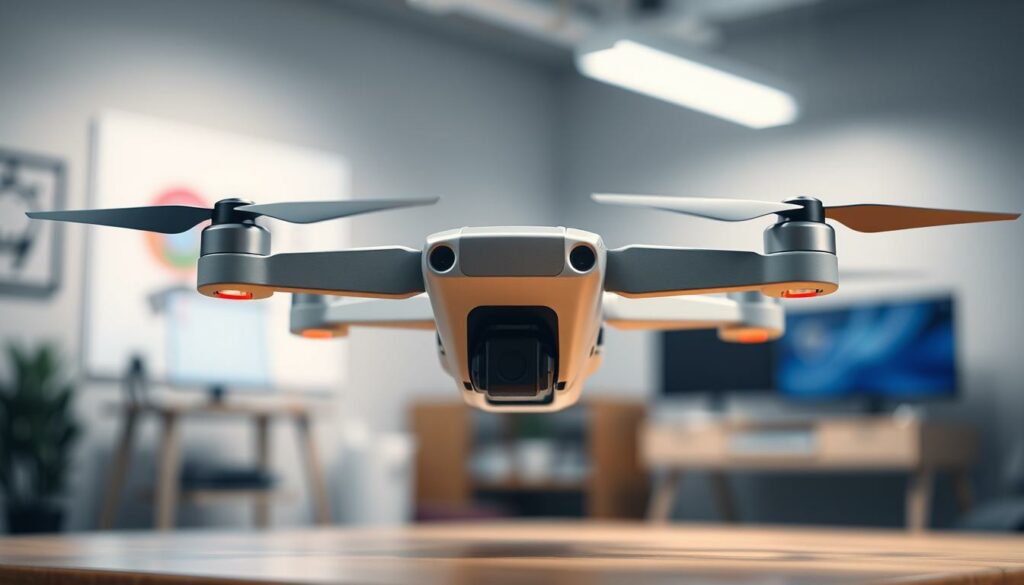
Compact and Lightweight Design Advantages
I’ve found the perfect size of this drone makes it ideal for spontaneous adventures. It slips easily into a jacket pocket, yet handles surprisingly well in breezy conditions. The sub-250g weight isn’t just about regulations—it means less damage during accidental bumps.
The folding arms protect the propellers during transport while keeping the footprint minimal. Build quality feels robust despite the lightweight construction, inspiring confidence during flight.
Innovative Functional Enhancements
One standout feature is the rotating gimbal that shoots both landscape and portrait orientations. This mini pro model excels for social media content creation in a way that larger drones cannot match.
Noise optimisation is another clever design element. The propellers and motors work together to reduce the typical high-pitched whine. This quieter operation lets you capture footage discreetly in public spaces.
Controller options provide flexibility too. You can choose between basic and integrated display models based on your preferences and budget. These features combine to create a remarkably versatile drone experience.
Imaging and Camera System Performance
When it comes to capturing stunning aerial footage, the camera system delivers results that rival much newer models. I’ve found the photographic capabilities genuinely impressive for a machine of this size and age.
Technical Specifications and Capabilities
The heart of this imaging system is a 1/1.3-inch Quad Bayer sensor that records 4K video at 60fps. With a 150 Mbps bitrate, the footage captures incredible detail and smooth motion.
What’s remarkable is that this exact same sensor appears in the latest model. The 48-megapixel photos benefit from dual native ISO technology, ensuring excellent dynamic range in challenging lighting.
Real-World Footage and Photo Quality
In practical use, the D-Cinelike colour profile provides flexibility without demanding advanced editing skills. Even the standard profile produces beautiful images straight from the camera.
The rotating gimbal is a game-changer for social media content. I can seamlessly switch between landscape and portrait orientations while maintaining full resolution capabilities.
After extensive testing, I can confidently say the quality remains professional-grade. Most users will find these imaging capabilities more than sufficient for their creative projects.
Flight Experience and Obstacle Avoidance
What truly makes this aircraft special is how it handles in real-world conditions, combining intelligent safety systems with responsive controls. The flying experience feels both secure and exhilarating, whether you’re capturing smooth cinematic shots or navigating through more complex environments.
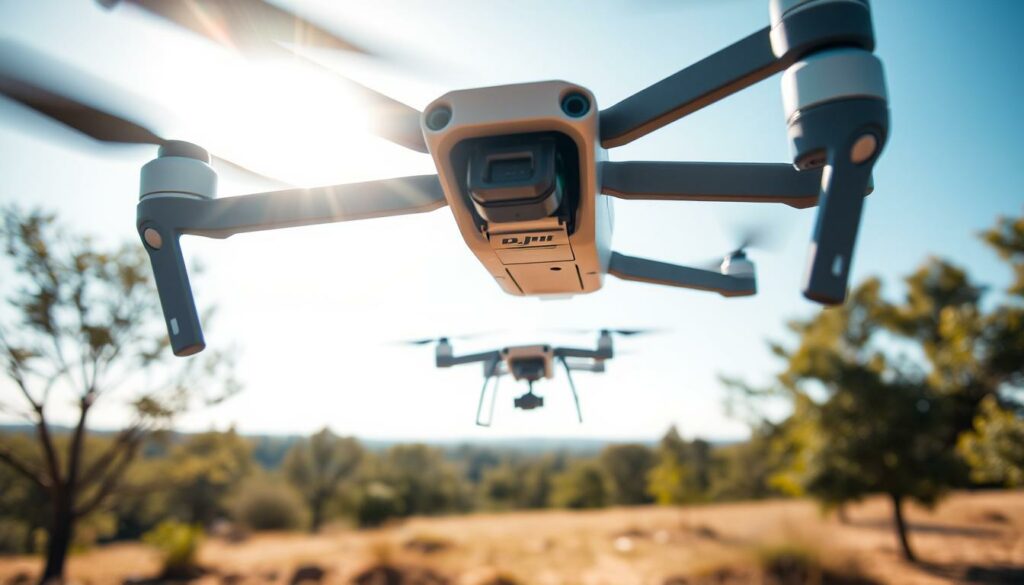
Three-Directional Obstacle Avoidance in Action
The three-way sensing system provides crucial protection during flight operations. Sensors monitor what’s ahead, below, and crucially, behind the aircraft.
I particularly value the backward detection. Having experienced bumps while reversing with an older model, this feature would have prevented those incidents completely. The system works reliably in various lighting conditions, giving me confidence during complex manoeuvres.
| Detection Direction | Primary Use Case | Real-World Benefit |
|---|---|---|
| Forward | Navigation and tracking | Prevents collisions during forward flight |
| Backward | Reverse flying and positioning | Eliminates blind spot risks |
| Downward | Landing and low-altitude flight | Ensures safe ground clearance |
Smooth Handling and Responsive Controls
The ActiveTrack focus locking is phenomenally good. It maintained lock on my vehicle at 22 mph and cleverly reacquired the subject after temporary obstructions.
Handling feels precise across all speed ranges. From slow cinematic movements to sport mode, the controls respond intuitively. This makes the flight experience enjoyable for pilots of all skill levels.
Wind stability is another strong point. I rarely fight against gusts, which lets me concentrate on capturing the perfect shot rather than constant corrections.
Transmission, Battery Life and Flight Time Insights
The transmission system and power management capabilities often determine how much creative freedom you’ll experience during flight operations. These behind-the-scenes features make the difference between a stressful session and smooth creative work.
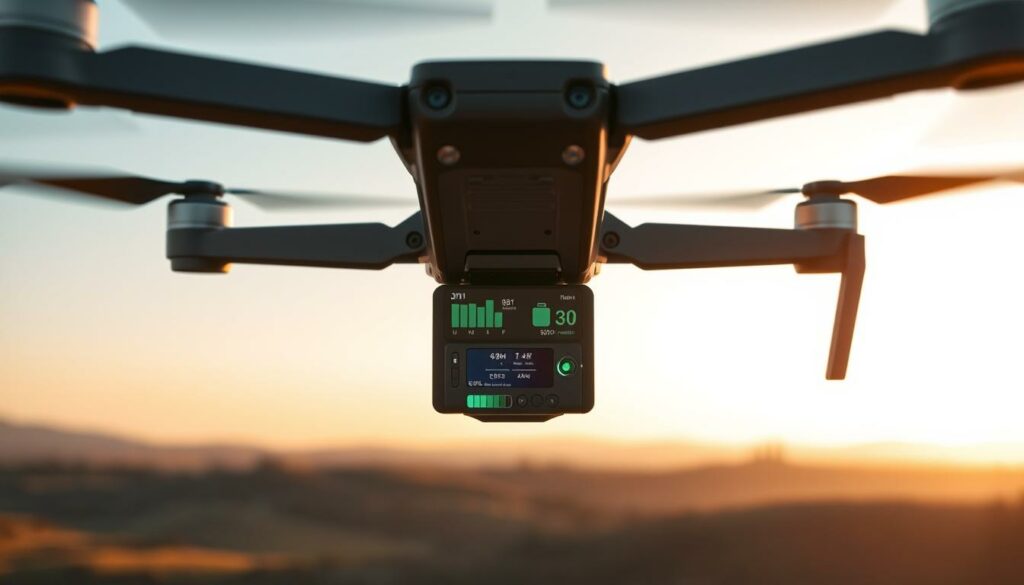
DJI O3 Transmission Reliability
I’ve found the O3 transmission system provides rock-solid connectivity that builds confidence during flights. While I don’t push extreme distances, the system’s stability in challenging environments is impressive.
Other pilots have demonstrated connections well over 5 kilometres, with one remarkable test reaching approximately 10 kilometres. What matters more to me is the quick reconnection capability if signal is temporarily lost.
The controller options offer excellent flexibility. You can choose the budget-friendly RC-N1 that uses your phone as a screen, or the integrated screen model for a streamlined experience. When using the RC-N1, I prefer a bright tablet for better visibility.
Evaluating Battery Endurance and Flight Time
The standard battery delivers respectable flight time that rarely leaves me feeling rushed. For most recreational sessions, the battery life proves perfectly adequate.
I strongly recommend the Fly More combo with multiple batteries if you plan extended field time. Managing battery endurance effectively means monitoring power levels and accounting for return journeys.
Wind conditions can significantly impact how long your drone stays airborne. The flight time per charge is competitive, allowing you to capture various shots without constant landings.
DJI Mini 3 Pro Review 2026: Value and Pricing Options
Let’s talk about what really matters for most shoppers – getting the best bang for your buck. The current pricing situation for this capable flyer is genuinely exciting, and it’s the main reason I decided to write this updated assessment.
The value proposition has become incredibly compelling for budget-conscious buyers. Today, you can access professional aerial capabilities without breaking the bank.
New Price Reductions and Refurbished Deals
The standard version with basic controller now costs under £600. That’s a substantial 21% discount from the original £759 launch price. More people than ever can afford this level of technology.
The integrated screen model offers excellent value at £729. You save significantly compared to the £999 launch cost. This all-in-one solution eliminates phone mounting hassles.
| Option | Controller Type | Current Price | Original Price | Savings |
|---|---|---|---|---|
| New | Basic | Under £600 | £759 | 21% |
| New | Integrated Screen | £729 | £999 | 27% |
| Refurbished | Basic | £479 | £759 | 37% |
| Refurbished | Integrated Screen | £585 | £999 | 41% |
Many people overlook the refurbished programme, which offers extraordinary value. I can get the mini pro with basic controller for just £479. That’s an absolute bargain for a drone of this capability.
The refurbished units come with identical one-year warranties as new products. DJI thoroughly inspects and repairs each device. You might find minor cosmetic marks, but functionality remains perfect.
The main challenge is availability. These deals sell out incredibly quickly. If you see the mini pro listed today, decide rapidly – it’ll likely be gone by the next day.
I’ve included link references you can bookmark and check daily. New stock appears regularly but disappears fast when price-conscious people snap them up. The 14-day exchange period lets you test thoroughly, though exchanges are only for other refurbished units.
Comparing the Mini 3 Pro and Mini 4 Pro
The choice between these two closely related models ultimately comes down to how you plan to use your new flying camera. Having flown everything from the original Mavic Pro to the latest Mavic Air, I can confidently assess what different pilots truly require from their equipment.
Feature Enhancements and Technical Upgrades
The newer model brings several significant improvements that advanced users will appreciate. Lateral obstacle avoidance provides complete omnidirectional protection, while the 360-degree ActiveTrack lets you trace custom flight paths on screen.
The O4 transmission system offers remarkable stability that’s difficult to improve upon. For serious video editors, the 10-bit D-Log M colour profile provides greater flexibility in post-production compared to the D-Cinelike option.
Choosing the Appropriate Drone for Your Needs
For most people, especially first-time buyers, the older model’s three-directional sensing is perfectly adequate. If you primarily shoot landscape videos or real estate content in open spaces, you’ll have everything you need.
The controller options and screen quality are comparable between both drones. Your decision should focus on whether you genuinely require those advanced pro features.
If you frequently fly in complex environments with obstacles on all sides, the newer model’s omnidirectional sensing justifies the extra cost. Likewise, if you plan extensive ActiveTrack usage, the path-tracing capability is worth the investment.
For budget-conscious learners, the older model represents incredible value. Both drones deliver professional-quality content with one controller and one button press.
Conclusion
Having weighed all the factors, I can now offer my definitive recommendation for aerial photography enthusiasts. After extensive testing, this drone remains an exceptional choice that won’t disappoint first-time buyers.
The mini pro represents the best of what this line offers. It combines professional capabilities with remarkable affordability. Today’s pricing makes it an incredibly smart investment.
While the newer model has its advantages, most people will find everything they need in this capable drone. The value proposition is simply outstanding, especially with refurbished options available.
I’m excited to see how the manufacturer continues to evolve compact flying cameras. Both models in the dji mini series deliver professional results that will make any buyer happy.
For complete information, check my comprehensive video review with updated links. My final advice: if you’re starting your aerial journey, this pro model is a purchase you won’t regret.
FAQ
Is the camera on this drone still good enough for creating content in 2026?
Absolutely. The 48MP photo sensor and 4K HDR video capabilities are still fantastic. For most hobbyists and even semi-professionals, the image quality is more than sufficient for social media, personal projects, and even some commercial work. It handles different lighting conditions beautifully.
How does the battery life hold up for a full day of flying?
The standard battery offers a solid flight time. I find it gives me plenty of opportunity to capture what I need. For longer sessions, the optional Plus battery is a game-changer, significantly extending your air time. It’s one of the best features for enthusiasts who want to fly without constant interruptions.
With the newer model available, why would I choose this one?
A> It often comes down to value. Since its release, the price has become very attractive. You get a tremendous amount of performance—like that superb camera and solid obstacle sensing—for a lower cost. If you don’t absolutely need the very latest upgrades, it represents brilliant value for money.
Is it difficult for a beginner to learn to pilot this aircraft?
Not at all. I found it incredibly user-friendly. Features like GPS stabilisation and the intuitive controls make it stable and easy to handle from your first flight. The QuickShots modes also help you create professional-looking videos with just a tap on the screen.
What is the real-world range like for the video transmission?
The O3 transmission system is impressively reliable. In a clear, open area, I’ve had a strong, stable video feed at distances far beyond what you’d typically need. It gives you great confidence to explore and frame your shots without worrying about losing the connection.
How effective is the three-way obstacle avoidance in practice?
It’s a very useful safety net. The sensors at the front, back, and below help prevent accidents, especially when flying in more complex environments or when you’re focused on getting the perfect shot. It’s not a full 360-degree system, so you still need to be aware of your surroundings, but it adds a significant layer of protection.
Can I use my smartphone with the remote controller?
Yes, you can. The standard controller requires you to clip your phone to the top. However, I highly recommend the model with the built-in screen. It’s so much more convenient, as you don’t have to deal with cables or your phone’s battery life, and the screen is bright enough for use on a sunny day.