
Have you ever wondered if capturing those breathtaking cityscapes after sunset with your aerial camera is actually permitted in the UK? Many pilots assume darkness means grounded operations, but I’m here to show you a different reality.
The truth is, both recreational enthusiasts and commercial operators can legally take to the skies after sunset. The Civil Aviation Authority focuses on safety rather than imposing time-based restrictions. Your operational authorisation remains valid around the clock if you’ve addressed after-dark operations properly.
However, successful after-dark operations require a fundamentally different approach than daytime sessions. I’ve learned through experience that preparation is everything. From understanding lighting standards to maintaining visual contact, each element demands careful attention.
This comprehensive guide will walk you through everything I’ve discovered. We’ll cover UK-specific rules, essential gear, and creative methods that transform your aerial photography. The opportunities for stunning visuals are incredible once you master these techniques.
Key Takeaways
- After-dark aerial operations are legally permitted in the UK for both hobbyists and professionals
- The Civil Aviation Authority emphasises safety requirements over time-based prohibitions
- Commercial operators’ authorisations remain valid 24/7 with proper risk assessments
- Successful after-dark sessions require different preparation than daytime operations
- Essential considerations include lighting standards and visual line of sight maintenance
- After-dark aerial photography offers unique creative opportunities unavailable during daylight
- Proper planning and equipment selection are crucial for safe and successful operations
Navigating UK Night Flying Regulations
Many pilots are surprised to learn that the UK’s approach to after-dark aerial activities is based on capability, not a blanket curfew. The Civil Aviation Authority (CAA) focuses on safety requirements rather than imposing time-based prohibitions. This pragmatic stance benefits both hobbyists and commercial drone pilots.
Understanding the distinction between recreational and commercial operations is crucial. If you’re flying for fun, you can operate after sunset by following the standard rules. However, commercial drone work requires your operational authorisation to explicitly cover these conditions.
Understanding CAA Requirements for Night Flights
My own experience getting authorisation was insightful. It wasn’t just a tick-box exercise. I had to demonstrate specific risk assessments for low-light scenarios and prove my training and competency. Your operations manual must be updated with procedures for maintaining visual line of sight and handling emergencies in darkness.
Operational Authorisation and Risk Assessments
The authorisation process ensures you’ve considered every aspect of safe night flights. This includes proving your aircraft has appropriate lighting. The goal is to show the CAA you can manage the unique challenges of a night operation safely.
Staying Compliant with Airspace Restrictions
It’s vital to remember that standard restrictions don’t vanish after sunset. No-fly zones around airports and other sensitive areas remain active 24/7. Always check for Temporary Flight Restrictions before any flights.
Some locations have extra restrictions due to wildlife or local bylaws. Using apps like Drone Assist is essential for staying within the law. All standard rules, like altitude limits and distances from people, still apply in the dark.
| Aspect | Recreational Pilot | Commercial Pilot |
|---|---|---|
| Authorisation Needed | Follows standard CAA regulations | Requires specific night operational authorisation |
| Documentation | Basic understanding of rules | Updated operations manual & risk assessments |
| Airspace Compliance | Must avoid all restricted airspace | Must avoid all restricted airspace |
Essential Drone Night Flying Regulations
The transition from daylight to darkness fundamentally transforms how pilots maintain visual awareness of their unmanned aircraft. What seems straightforward during the day becomes a complex challenge after sunset.
Successful operations require understanding these fundamental shifts in approach. The regulations remain consistent, but their practical application changes dramatically.
Maintaining Visual Line of Sight (VLOS) After Dark
During daytime sessions, I rely on seeing the aircraft’s physical shape and orientation against the landscape. This visual information disappears completely when darkness falls.
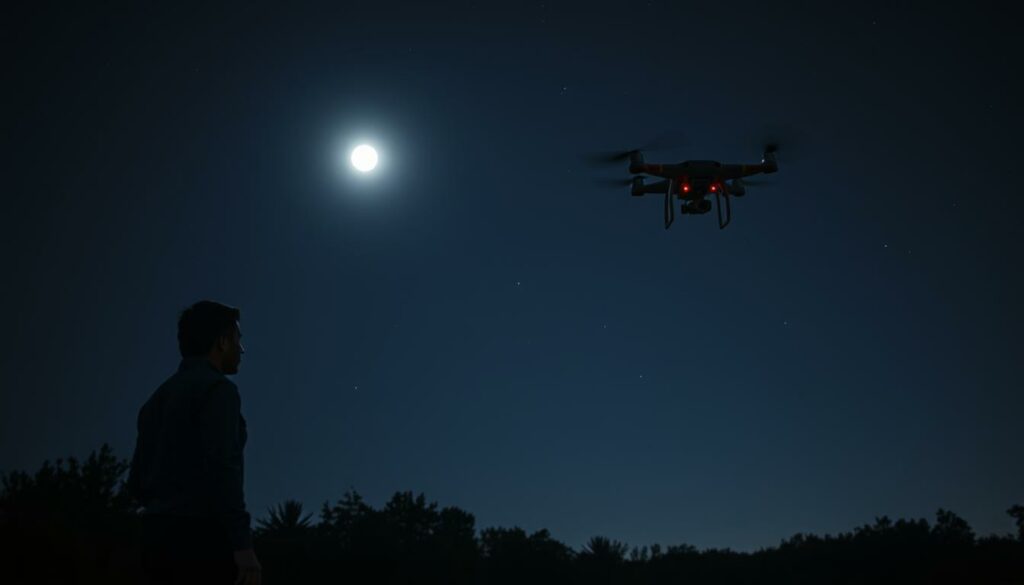
After sunset, maintaining proper visual line sight means tracking points of light rather than the aircraft body. This makes judging distance and speed considerably more challenging.
Orientation becomes critical—I must identify forward-facing red lights and rear-facing green lights. If I cannot determine which direction the aircraft is pointing, I’ve effectively lost control.
Lighting Standards and Vital Pre-Flight Checks
The CAA mandates that aircraft lights must be visible from at least 3 miles (5km). From my experience, most built-in LEDs fall short of this legal requirement.
Pre-flight checks become absolutely essential. I test every single light function and scrutinise battery levels obsessively. Scouting the area during daylight helps identify hazards that become invisible after dark.
| Aspect | Daytime Operations | Nighttime Operations |
|---|---|---|
| Primary Visual Reference | Aircraft shape and physical features | Navigation and orientation lights only |
| Distance Judgment | Against landscape and objects | Based on light intensity and movement |
| Orientation Awareness | Direct observation of aircraft facing | Colour-coded light identification |
| Recommended Operating Distance | Standard visual range | Halved from daytime distance |
Effective after-dark operations demand slower, more deliberate movements. Constant verification of position and orientation ensures compliance with regulations and maintains safety.
Choosing the Right Equipment and Lighting for Night Flights
Selecting the right gear for after-dark operations transforms a challenging activity into a safe and rewarding experience. The correct lights are not optional accessories; they are your primary tool for maintaining orientation and situational awareness.
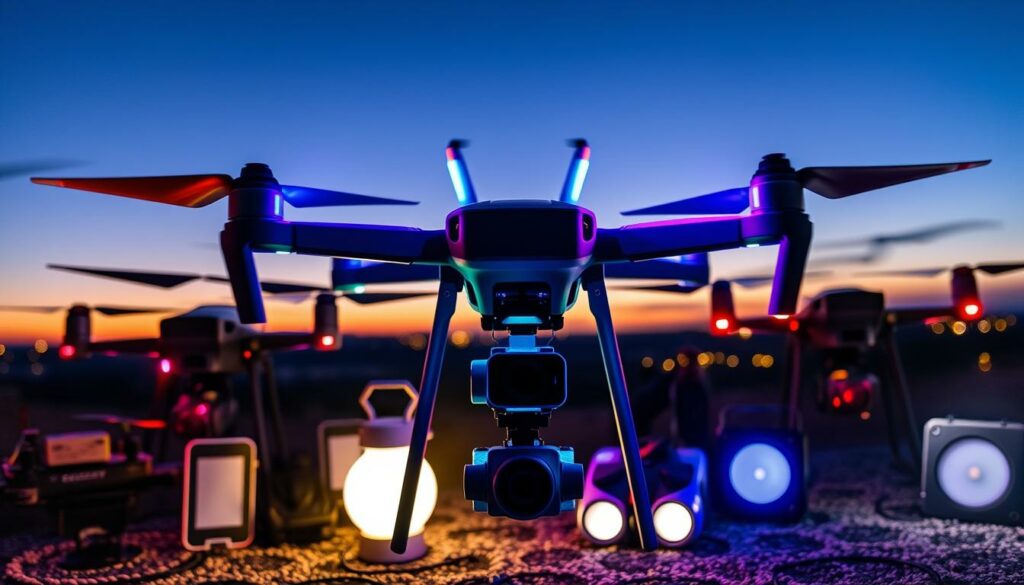
I quickly learned that most built-in LEDs on consumer drones are insufficient for serious work. They often fail to meet the legal requirement of being visible from at least 3 miles away. This realisation led me to invest in aftermarket strobe lights from trusted brands like Firehouse Technology and Lume Cube.
Upgrading Built-In LEDs with Aftermarket Solutions
Attaching bright, flashing anti-collision strobes to the arms and top of your aircraft is a small investment with a massive return in safety and compliance. These lights must flash to clearly differentiate your craft from stars or other aircraft, drastically improving its visibility.
This upgrade is crucial for any operation in low-light conditions, whether you’re a beginner or a seasoned professional.
Gear Recommendations for Hobbyists and Professionals
Choosing an aircraft with excellent low-light capabilities is equally important. Some models are naturally better suited for this work. Battery management becomes critical, as running additional lighting consumes extra power, reducing flight time.
Always carry multiple fully-charged battery packs and plan for shorter sessions.
| Model | Key Feature | Best For |
|---|---|---|
| DJI Mavic 3 Series | Hasselblad camera, multi-directional sensing | Stunning aerial photography |
| Autel Evo Lite+ | Large 1-inch sensor, adjustable aperture | Low-light photography enthusiasts |
| Parrot Anafi USA | Thermal imaging, 32x zoom | Public safety missions in dark areas |
This equipment empowers both hobbyists and professionals to operate confidently and capture incredible footage when the sun goes down.
Mastering Visual Line of Sight and Flight Safety at Night
The shift from daylight to evening operations demands a fundamental rethinking of how we maintain orientation. What works perfectly during the day becomes challenging when darkness falls.
Techniques for Effective VLOS in Low-Light Conditions
Maintaining visual line sight after sunset requires interpreting light patterns rather than seeing the aircraft itself. I start sessions during twilight to let my eyes adjust gradually.
Knowing orientation lights instinctively is crucial. Red means forward, green indicates rear. This split-second recognition maintains control when visibility drops.
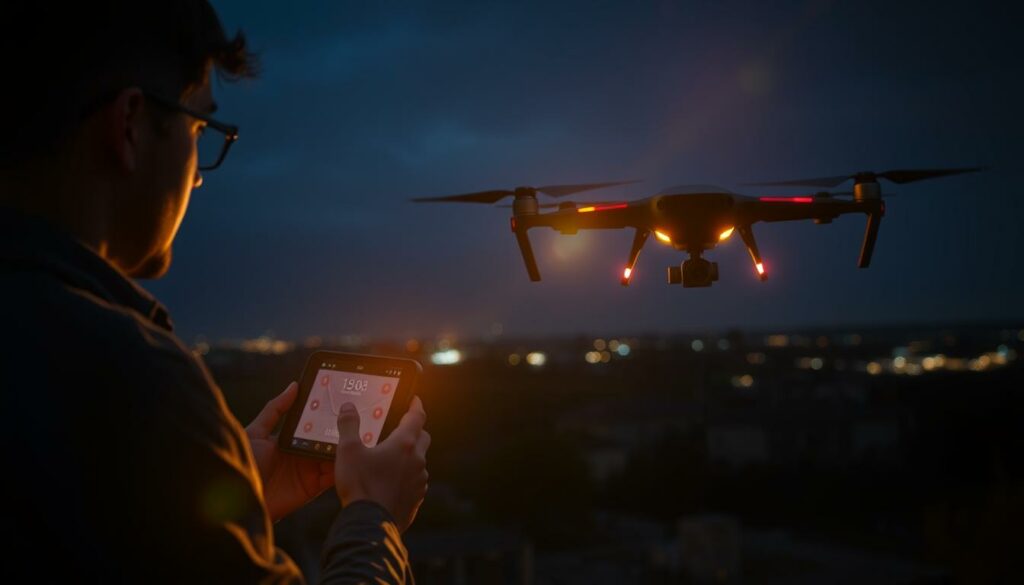
I halve my usual daytime distance when operating after dark. The further the craft travels, the harder it becomes to maintain proper line sight. Slow, deliberate movements prevent disorientation.
Pre-Flight Safety Protocols and Battery Management
My pre-flight routine becomes meticulous after sunset. I check battery voltage multiple times and test every light function. GPS lock and controller charge receive extra attention.
Scouting the area during daylight helps identify hazards like power lines that become invisible at night. These safety measures reduce collision risks significantly.
Weather conditions affect operations differently after dark. Fog, dew, and temperature drops can impact sensors and motors. Always have backup power available for emergency situations.
Creative Techniques for Capturing Stunning Night Aerials
Capturing the world from above after sunset offers creative possibilities you simply can’t find during daylight hours. The transformation of familiar landscapes under artificial illumination creates magical scenes perfect for aerial photography.
My approach begins with thorough preparation. I scout potential filming spots when it’s still light to identify interesting features and safe flight corridors.
Planning Your Flight Path for Optimal Lighting
I map out my route considering how different light sources will interact. Street lamps, building illuminations, and vehicle headlights become my artistic tools.
Choosing wide open rural locations ensures I won’t disturb residents while capturing breathtaking scenes.
Using Slow, Deliberate Movements for Stable Shots
Gentle gimbal pans and gradual altitude changes produce professional results. Quick movements that work during the day often create blurry footage in low-light conditions.
This careful approach maintains stability and allows the camera to capture clean, sharp images.
Exploiting Long Exposures and Cinematic Angles
Long exposure photography transforms ordinary scenes into extraordinary visual experiences. Light trails from traffic and the soft glow of distant cities create dynamic compositions.
High establishing shots and low-angle approaches towards illuminated buildings work particularly well after dark.
| Scenario | Recommended Technique | Best Equipment Feature |
|---|---|---|
| Cityscape Photography | Long exposure from high angles | Large sensor for low-light performance |
| Light Trail Captures | Slow panning movements | Adjustable aperture settings |
| Rural Landscape Shots | Static hovering positions | Enhanced stabilisation systems |
Modern aircraft with improved low-light capabilities have revolutionised what’s possible for both hobbyists and professionals. The creative rewards are incredible when approached with proper planning and respect for safety rules.
Expanding Your Drone Night Flying Skills
Whether you’re a hobbyist or professional, advancing your capabilities for evening sessions demands specific preparation. The approach differs significantly between recreational enthusiasts and commercial operators.
Training Tips for Enhanced Night Flight Confidence
Commercial pilots must complete formal training modules as part of their GVC or A2 CofC qualifications. Recreational flyers aren’t legally required to take courses, but I strongly recommend voluntary training for everyone.
Building confidence requires a gradual progression. I start with extensive daytime practice before moving to twilight sessions. Only when completely comfortable do I graduate to full darkness.
Adapting to Unfavourable Weather and Ambient Conditions
Weather awareness becomes crucial after sunset. I avoid fog, heavy rain, or strong winds that exceed my equipment’s capabilities. Temperature drops can affect battery performance and sensor accuracy.
| Aspect | Recreational Pilots | Commercial Pilots |
|---|---|---|
| Mandatory Training | Not required | Formal night modules included |
| Recommended Practice | Twilight sessions | Structured progression |
| Safety Focus | Voluntary courses | Risk assessment protocols |
Proper preparation reduces risks significantly. I always scout unfamiliar areas during daylight and maintain solid manual flying skills as backup. Advanced features like thermal imaging supplement fundamental piloting abilities.
Conclusion
Responsible after-dark piloting represents the pinnacle of professional drone operation in the UK. The freedom to conduct these sessions comes with specific responsibilities that ensure everyone’s safety.
Commercial operators must secure proper authorisation covering evening work. All standard airspace restrictions remain active after sunset. Investing in quality lighting and thorough location scouting during daylight hours is essential.
These operations aren’t just for creative photography. They serve vital roles in emergency response and infrastructure inspection. Proper training builds the confidence needed for challenging low-light conditions.
Ultimately, accountability defines successful after-dark work. The sky may be open, but our commitment to safe, legal operations must never waver. This approach maintains public trust while unlocking extraordinary possibilities.
FAQ
Do I need special permission to fly my drone after dark in the UK?
Yes, you absolutely do. For most operations, you’ll need an Operational Authorisation from the Civil Aviation Authority (CAA). This involves submitting a detailed risk assessment that proves you can manage the unique risks of a night flight safely. Hobbyists flying strictly under the Open Category have very limited options for these activities.
What are the most critical safety measures for a night operation?
A> My top priorities are maintaining a clear visual line of sight and proper lighting. I ensure my aircraft has bright, anti-collision lights visible for at least three miles. A thorough pre-flight check is also vital, paying extra attention to battery power and ensuring my own night vision is fully adapted before takeoff.
Can I use the standard lights that come on my drone, or do I need to upgrade?
While many models have built-in LEDs, I often recommend adding aftermarket lighting solutions for enhanced visibility and safety. Strobe lights that are brighter and have different flash patterns make it much easier for me to keep track of my aircraft’s orientation and location in the dark sky.
How do I maintain a visual line of sight when it’s so dark?
This is a key skill to practise. I rely heavily on my lighting system and choose a flight path that keeps the device against a contrasting background, like a city skyline. I also start with shorter, closer flights in familiar areas to build my confidence in judging distance and movement with limited visibility.
What should I do if I have a power failure or other emergency at night?
Preparation is everything. I always ensure my return-to-home (RTH) settings are correctly configured and tested. I also scout my location in daylight to identify safe, lit emergency landing areas. Having a powerful torch in my kit is essential for managing any ground-based issues after an unplanned landing.
Are there specific techniques for getting better aerial photos and videos at night?
Certainly! I plan my route to incorporate interesting light sources. Using slow, deliberate movements helps create stable footage. For photography, experimenting with manual camera settings like long exposures can produce stunning light trails and capture more detail in low-light conditions than automatic modes.