
Have you ever wondered why your expensive aerial equipment sometimes struggles to capture that perfect shot, even when everything else seems perfect?
With over a million registered drones in the USA alone, according to Federal Aviation Administration data, aerial photography has become incredibly popular. Many of these devices are used commercially, while even more serve recreational purposes. Most modern drones come with limited internal storage, making external storage solutions absolutely essential for capturing stunning 4K footage and high-resolution photographs.
I’ve learned through extensive field testing that your drone’s performance is only as reliable as the storage media you choose. This isn’t about purchasing the most expensive option available. It’s about understanding which specifications genuinely matter for your specific aerial photography needs and shooting style.
The year 2025 has introduced some excellent options to the market, including brands like SanDisk Extreme Pro and Digiera that I’ve personally put through their paces. In this guide, I’ll share my perspective on what makes a storage device truly worthy of your investment, focusing on real-world factors like write speeds, capacity, durability, and compatibility.
Key Takeaways
- External storage is essential for capturing high-quality aerial footage due to limited internal drone capacity
- Your drone’s performance directly correlates with the quality of storage media you select
- Understanding specific technical requirements matters more than simply choosing expensive options
- Key considerations include write speeds, storage capacity, durability, and device compatibility
- Recent market developments in 2025 have introduced excellent new options worth considering
- Personal field testing reveals which specifications perform best in real-world UK conditions
- The right choice depends on your individual drone model and photography style
Getting to Know Drone Memory Cards
My first drone filming session ended abruptly with a corrupted file, teaching me a harsh lesson about storage media. I quickly realised these tiny components aren’t mere accessories but fundamental to capturing quality aerial footage.
https://www.youtube.com/watch?v=8q7FxPoZh9U
My Journey with Drone Videography and Storage Solutions
Early experiences with dropped frames during 4K recording showed me how critical proper storage solutions are. I learned that insufficient write speeds lead directly to missed opportunities and unusable footage.
Different shooting scenarios demand varied approaches. Short recreational flights need different capacity planning compared to extended commercial projects.
Why Write Speeds and Storage Capacity Are Essential
Manufacturers like DJI specify minimum requirements for good reason. Their recommendation of 128GB capacity with UHS-I Speed Grade 3 support for 4K at 60fps represents just the starting point.
Understanding these technical requirements upfront saves money, frustration, and potentially irreplaceable footage. For professional-quality work, I’ve found these baselines essential:
| Video Resolution | Minimum Write Speed | Recommended Video Class | Typical Capacity Needed |
|---|---|---|---|
| Full HD | 70MB/s | V30 (UHS-I) | 64-128GB |
| 4K/8K | 165MB/s | V90 (UHS-II) | 128-256GB |
| High-Speed Burst Photos | 90MB/s | V60 | 64-128GB |
Meeting these specifications ensures smooth recording without dropped frames. It also future-proofs your investment as camera technology advances.
Technical Specifications and Performance Factors
Understanding storage specifications transformed my approach to capturing reliable drone footage. The technical labels on these components directly impact whether your aerial recordings succeed or fail.
Understanding Video Speed Class, UHS Ratings and Write Speeds
Let me simplify the sometimes confusing world of video speed class ratings. The V30, V60, and V90 symbols indicate minimum sustained write speeds of 30, 60, and 90 MB/s respectively.
For basic 4K video, V30 provides adequate performance. However, V60 becomes essential for slow-motion capture or HDR workflows.
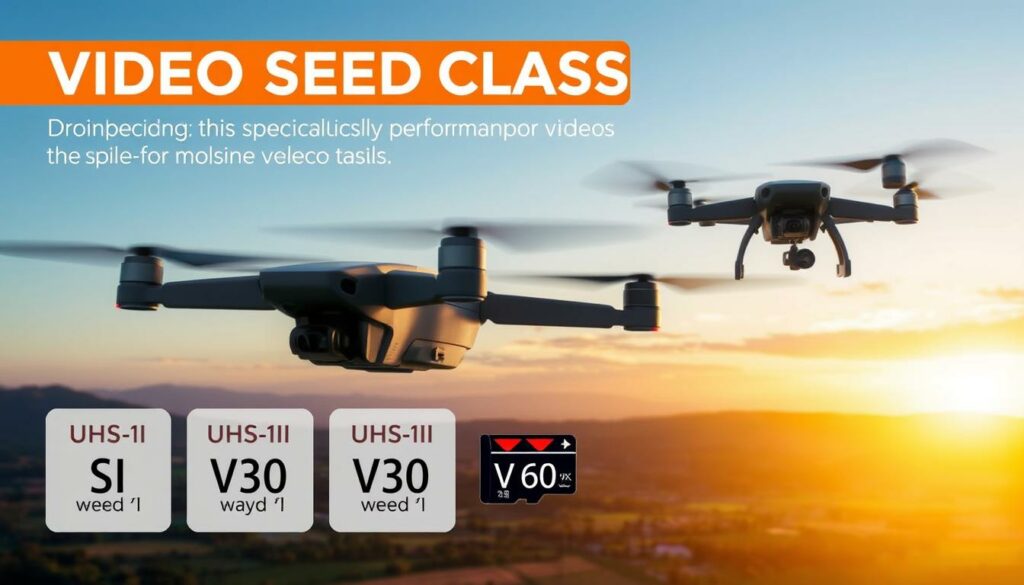
The difference between UHS-I and UHS-II models is significant. UHS-II components feature a second row of contact pins, delivering read speeds up to 312 MB/s.
Here’s an interesting fact: DJI’s consumer drones max out at 120 Mbps (15 MB/s) write speed. This means you don’t need the absolute fastest options for capture purposes.
Evaluating Storage Capacity for 4K and Beyond
Choosing the right capacity depends entirely on your shooting style. For most users, 32GB-64GB provides sufficient space.
If you’re disciplined about swapping media between flights, 16GB works well. For extended shooting sessions or holidays, I recommend 128GB to avoid frequent changes.
Understanding these technical specifications helps you make informed decisions rather than falling for marketing hype. Your investment should match your actual aerial photography needs.
Choosing the Best Memory Cards for Drones
After extensive field trials from Cornwall to the Scottish Highlands, I’ve identified the most reliable storage solutions for aerial photography. Britain’s varied climate presents unique challenges that separate premium options from mediocre ones.
Comparing Field-Tested Options and Performance in UK Conditions
Testing in Britain’s damp highlands and coastal regions revealed significant differences in reliability. The Digiera LSU200 UHS-II V90 impressed me with consistent 280MB/s write speeds even during temperature fluctuations.
Humidity-resistant construction proved essential for Scottish shoots. Both the SanDisk Extreme Pro and Digiera options handled these conditions admirably.
My Personal Recommendations: SanDisk Extreme Pro vs Digiera
For professional work with cinema drones, I recommend both the SanDisk Extreme Pro and Digiera LSU200. The Digiera offers slightly faster 280MB/s versus 260MB/s write speeds.
However, the SanDisk Extreme has proven reliability over a decade. For value-conscious users, the Digiera LSU100 provides excellent 4K/60fps performance at a lower price point.
I always purchase from reputable UK retailers like Amazon to avoid counterfeits. Other trusted brands include Kingston, Lexar, and Samsung for alternative options.
Optimising Your Drone Footage Workflow
The real test of your storage choice begins when you transfer files from your aerial device to your editing suite. Many photographers focus solely on capture quality, but efficient workflow management separates professional work from amateur recordings.
Your media’s capabilities continue to impact your project long after the flight ends. I’ve learned that optimising this process saves valuable time and protects your creative work.
How Write Speed Influences Editing Efficiency
Faster write speeds prevent frustrating issues during recording sessions. They eliminate dropped frames and buffer overheating that can ruin dynamic action scenes.
When your storage media handles data efficiently, you capture smooth, uninterrupted videos. This reliability means less time fixing technical problems and more time focusing on creative editing.

Tips for Quick File Transfers and Reliable Storage Management
I always use a UHS-II reader with USB 3.2 Gen 2 connectivity for optimal transfer speeds. This setup dramatically reduces the time between shooting and editing your aerial videos.
Proper storage management protects your valuable data. I recommend using protective holders with foam padding and avoiding moisture exposure. Never remove media during file transfers.
For multi-battery sessions, dual-slot readers allow simultaneous offloading. I also rotate my storage devices regularly, as older units gradually lose performance over time.
Investing in proper file management pays dividends in workflow efficiency. It ensures your creative time is spent editing rather than waiting for transfers or recovering lost data.
Additional Considerations for Memory Cards
Flying in Britain’s unpredictable climate has taught me that durability matters as much as speed when choosing storage. Beyond technical specifications, how your media withstands real-world conditions determines whether your aerial footage survives intact.
Environmental Durability: Temperature, Shock, and Waterproofing
I always verify genuine temperature ratings (-25°C to 85°C) after losing footage to condensation. Proper waterproof certification (72-hour submersion) proved essential during Scottish Highland shoots.
Shock resistance became crucial when my drone experienced a hard landing. X-ray proofing matters for frequent travellers, as airport scanners can damage unprotected media.
Brands like SanDisk Extreme Pro and Digiera actually test their claims under real conditions. This verification separates reliable options from marketing hype.
Practical Tips for Routine Card Maintenance and Data Backup
I store my media in anti-static sleeves with clear labels indicating content. Regular physical inspection helps spot damage before it causes data loss.
For commercial work, I swap storage after each flight to minimise potential losses. This practice saved me when a card corrupted during transfer.
Professional photographers typically carry 4-5 high-performance units. Intermediate users need several 64GB options, while hobbyists manage with a couple of 32GB versions.
Correct formatting based on your drone’s settings prevents corrupted file headers. Proper maintenance ensures your investment delivers consistent performance over time.
Conclusion
The journey to finding reliable storage for your drone recordings doesn’t have to be complicated when you understand what truly matters. Throughout this guide, I’ve shared my perspective on selecting components that protect your creative work.
My top recommendations remain the SanDisk Extreme Pro and Digiera LSU200 for professional aerial photography. Both deliver exceptional performance and reliability that I trust completely.
Understanding technical specifications like video speed class ratings and sustained write speeds empowers you to make smart choices. Your ideal selection depends on your shooting resolution, capacity needs, and environmental conditions.
Always prioritise quality and reliability over budget options. Lost footage from component failure costs far more than any initial savings. Proper workflow practices and routine maintenance extend your investment’s lifespan.
Investing in the right storage solution—whether premium like the SanDisk Extreme Pro or excellent-value Digiera options—provides peace of mind that protects your aerial work for years to come.
FAQ
What is the most important specification to look for in a drone card?
For me, the write speed is absolutely critical. It determines whether your drone can record high-quality video like 4K or 1080p smoothly without dropping frames or stopping the recording entirely. I always check the Video Speed Class (VSC) and UHS Speed Class ratings first.
How much storage capacity do I realistically need for my drone?
It really depends on your projects. I find that a 128GB or 256GB microSD card offers a great balance, allowing me to capture plenty of high-bitrate footage without constantly swapping cards. For longer shoots or higher-resolution video, I’d lean towards 256GB for that extra peace of mind.
Are all microSD cards with the same capacity suitable for drone photography?
Definitely not. Capacity is just one part of the puzzle. A card with a slow write speed might hold your photos and videos, but it could cause your camera to buffer, potentially missing that perfect shot. Performance and reliability are just as important as the amount of storage.
Can I use the same memory card from my phone in my drone?
You might be able to, but I wouldn’t recommend it for serious videography. Cards designed for phones often don’t have the sustained write speeds needed for recording high-resolution drone video. Using a dedicated, high-performance card like a SanDisk Extreme Pro ensures optimal results.
What does the ‘V30’ or ‘V60’ rating on a card mean for my footage?
Those numbers refer to the Video Speed Class, which indicates the minimum sustained write speed in megabytes per second (MB/s). A V30 rating guarantees at least 30 MB/s, which is suitable for 4K recording. For more demanding codecs or higher frame rates, I look for a V60 or V90 rating.
How can I tell if my memory card’s write speed is fast enough?
A> I always check my drone’s user manual first, as it will list the minimum speed requirements for different video qualities. You can also use a card reader and software on your computer to test the actual write speed of your microSD card to see if it meets the spec.
Why is a fast card reader important for my workflow?
After a long day of shooting, a slow reader can really bottleneck your process. A high-speed USB 3.0 reader allows for much quicker file transfers to your computer, saving you valuable time when you’re eager to start editing your aerial footage.