
What if I told you that the most challenging lighting conditions for aerial photography could actually produce your most breathtaking results?
Capturing stunning aerial content during sunrise and sunset presents unique opportunities that simply aren’t available during brighter hours. While taking high-quality still photos in good lighting is straightforward, the magic truly happens when the sun dips below the horizon.
I’ve discovered that these golden and blue hour moments are absolutely worth the extra technical effort. The soft, diffused illumination creates atmospheric scenes that midday conditions cannot replicate. Modern aerial cameras have evolved significantly to handle dim environments better than ever before.
Even advanced models with larger sensors can struggle once available illumination diminishes. The shutter speed becomes impractically slow, requiring specific techniques to achieve clean, professional-grade results. This guide focuses on practical, field-tested methods I’ve personally used to extend flying time into those magical twilight hours.
While aerial cameras don’t perform as well as dedicated ground equipment in challenging lighting, with the right approach you can still capture spectacular imagery. The principles become straightforward once you understand how your equipment responds to diminishing light conditions.
Key Takeaways
- Golden and blue hour filming offers unique atmospheric opportunities not available during brighter conditions
- Modern aerial equipment has significantly improved for challenging lighting scenarios
- Specific techniques are required to overcome technical limitations at dusk and dawn
- Understanding your camera’s response to diminishing light is crucial for success
- Practical field-tested methods can extend your productive filming window
- Professional-quality results are achievable with the right approach to camera settings
- Twilight hours provide soft, diffused illumination perfect for cinematic aerial content
Understanding the Challenges of Night and Low Light Environments
As an experienced aerial photographer, I’ve learned that working in dim lighting requires a completely different approach than daytime shooting. The technical limitations become much more apparent when natural illumination fades.
Many aerial cameras struggle significantly compared to traditional ground equipment in these conditions. Their smaller sensors and inability to use tripods create fundamental challenges that affect overall performance.
Exploring the Impact of Diminished Light on Aerial Footage
When available light decreases, your camera’s sensor must work much harder. This leads to slower shutter speeds and higher ISO settings. The result is often increased digital noise and reduced image quality.
Even advanced models with 1-inch sensors face limitations as darkness approaches. In complete darkness, most consumer-grade equipment cannot capture usable footage without additional lighting sources.
| Lighting Condition | Key Characteristics | Primary Challenges |
|---|---|---|
| Urban Night | Artificial street lighting provides some ambient illumination | Mixed lighting sources create colour balance issues |
| Rural Darkness | Minimal ambient light, often near total darkness | Requires external lighting for usable footage |
| Blue Hour | Soft, even natural illumination before complete darkness | Brief 20-40 minute window for optimal shooting |
Dusk, Dawn and Blue Hour Dynamics
The transition periods around sunrise and sunset offer unique opportunities. The blue hour provides beautiful, even illumination that adds depth and colour to aerial scenes.
However, these optimal conditions are surprisingly brief. You typically have just 20-40 minutes of quality shooting time before darkness sets in completely. Planning and quick execution become essential during these precious windows.
Understanding these environmental factors helps you anticipate challenges and prepare accordingly. Different locations dramatically affect your equipment’s capabilities as natural light diminishes.
Preparing Your Drone and Camera Settings for Low Light Conditions
The success of your dawn or dusk aerial photography largely depends on how well you prepare beforehand. I’ve found that meticulous planning makes all the difference when working with limited natural illumination.
Pre-Flight Planning and Equipment Checklist
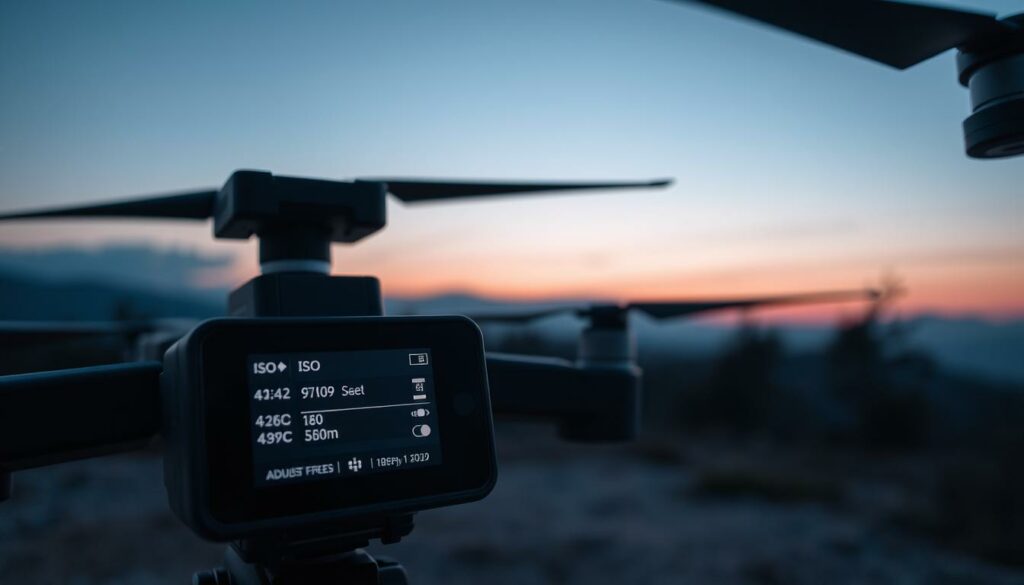
Before any twilight session, I conduct daylight reconnaissance of my location. This helps identify potential hazards that won’t be visible in dim conditions. My essential equipment checklist includes fully charged batteries—cold temperatures drain power faster—along with anti-collision lights and backup memory cards.
Sensor size significantly impacts performance in challenging lighting. Models like the DJI Mini 4 Pro with its 1/1.3-inch sensor and f/1.7 aperture excel in these environments. Larger sensors simply gather more available light.
Optimising Settings: ISO, Shutter Speed and Aperture
Understanding the exposure triangle is crucial for aerial work. I keep my aperture wide open at f/2.8 or lower to maximise light intake. This reduces depth of field but dramatically improves exposure.
For shutter speed management, I aim to keep it faster than 1 second when possible. This minimises motion blur from aircraft movement. My ISO strategy starts in the 400-1600 range to balance brightness and noise.
Shooting in manual mode gives me full control as light conditions change rapidly. I always use RAW format rather than JPEG for greater flexibility in post-processing. Checking the histogram ensures proper exposure without clipping shadows or highlights.
Essential Techniques for Drone Low Light Filming
There’s a secret weapon in my aerial photography toolkit that consistently delivers remarkable results in dim conditions. This approach lets me capture scenes that would otherwise be too dark for conventional methods.
Utilising Burst Mode and Image Stacking
I regularly use high ISO stacking, a technique borrowed from astrophotography. By taking multiple photos of the exact same scene, editing software can separate the consistent image from random noise.
DJI equipment offers a built-in burst mode that captures 3 or 5 consecutive images. I always choose the 5-image option for better stacking results. This approach significantly reduces visible grain in final outputs.
My field workflow begins with composing the shot carefully. I set the shutter speed as fast as realistically possible while increasing ISO to the 800-1,600 range. Checking the histogram ensures proper exposure before shooting.
The critical factor is keeping everything completely still during capture. At 1 second per image, the aircraft must remain motionless for 5 full seconds. I never touch the controller until the sequence fully completes.
While I’ve successfully recovered photos shot at ISO 3,000+, starting with cleaner source material always produces superior outcomes. Taking more frames improves your chances—if one image blurs, you have backups.
Capturing Excellent Footage: Tips for Minimising Noise and Enhancing Image Quality
My journey to capturing clean footage at dusk taught me that ISO and shutter speed decisions make or break your results. The fundamental challenge lies in the aircraft’s inherent instability—unlike tripod-based photography, you’re working with vibrating motors and air currents.
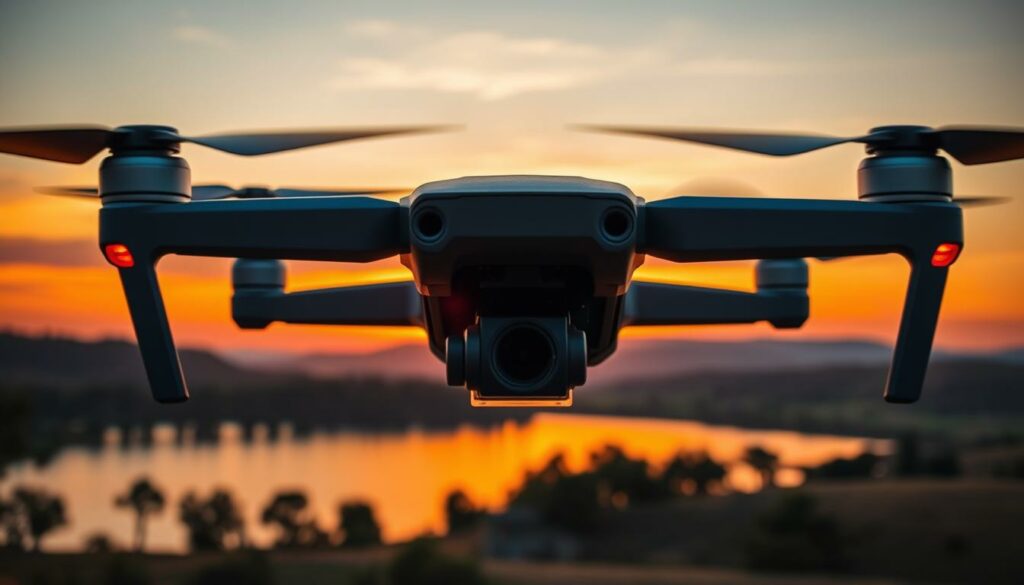
I’ve developed a simple rule for shutter management: keep speeds faster than 1 second when possible. While longer exposures can work in perfect conditions, your success rate drops dramatically as time increases. Even slight breezes can ruin otherwise perfect shots.
Managing High ISO and Exposure Challenges
The trade-off between ISO and shutter speed becomes critical in dim environments. I often choose higher ISO settings with faster shutter speeds rather than risking motion blur. Modern noise reduction handles grain better than software can fix blurry photos.
Wind conditions dramatically affect your outcomes. On calm evenings, I’ve achieved sharp 3-second exposures. During breezy nights, even half-second shots can show movement. Always check your images at 100% zoom before moving locations.
My key advice? Take many more shots than you think you need. When working with slower shutter speeds, capture extra frames as insurance against occasional blur. This simple practice has saved countless sessions when conditions seemed perfect but produced unexpected motion.
Post-Processing: Refining Your Low Light Images and Footage
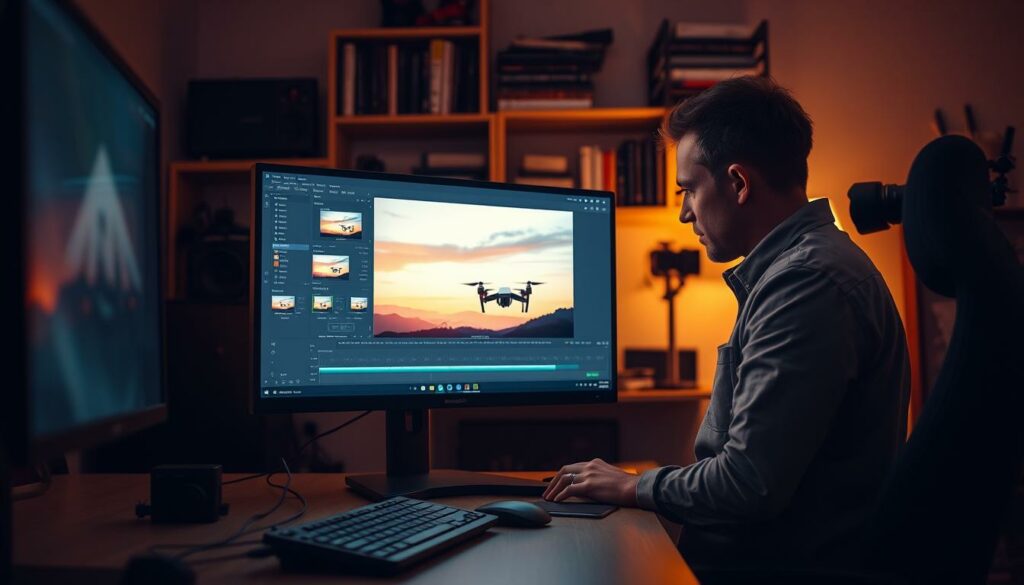
The real magic of twilight aerial work happens not in the sky, but on your computer screen during the editing process. This crucial stage transforms raw captures into polished photographs that truly capture the atmosphere of dawn or dusk.
Adjusting Exposure and Enhancing Colours
My editing workflow begins with careful exposure adjustments. I gently lift shadows to reveal hidden details while managing highlights to prevent blown-out areas. This balanced approach maintains the natural feel of twilight scenes.
Colour enhancement comes next. I boost vibrancy selectively, emphasising warm sunrise tones or cool blue hour hues. Contrast adjustments help separate elements within the frame, creating depth and visual interest.
Noise Reduction and the Art of Image Stacking
For burst mode photos, I use a powerful stacking technique in Photoshop. After opening images as layers, I auto-align them to correct minor movement. Converting to a Smart Object allows me to apply the “Mean” stacking mode.
This process averages pixel values across all photos, preserving consistent details while eliminating random noise patterns. The results are remarkably clean images with minimal grain.
Selective sharpening completes my workflow. I focus on key areas rather than applying global sharpening, which can emphasise remaining noise in smooth areas like skies.
Safety and Legal Considerations for Night Drone Filming in the UK
Many pilots are surprised to learn that night flying in Britain is perfectly legal, provided you follow specific rules. The Civil Aviation Authority has clear guidelines that ensure safe operations during these challenging conditions.
Understanding these requirements is just as important as mastering your camera settings. I always prioritise safety and compliance before any evening session.
Complying with CAA Regulations and Maintaining VLOS
Visual Line of Sight (VLOS) remains mandatory throughout your flight. You must maintain direct visual contact with your aircraft at all times.
This becomes particularly challenging as darkness increases. Proper lighting helps, but your awareness is crucial.
Registration depends on your equipment’s weight. Drones under 250g are generally exempt from full certification.
Heavier models require CAA registration and operator competency certification. Standard restrictions like the 400-foot altitude limit still apply after sunset.
Battery Management, Weather Checks and Anti-Collision Lighting
Cold evening temperatures drain batteries faster than daytime flying. I always start with fully charged batteries and monitor levels more frequently.
Weather conditions require extra attention at night. Temperature inversions can create unexpected wind patterns.
Your aircraft must have anti-collision lights visible from three statute miles. I recommend at least one green flashing light for better visibility.
Conduct daylight reconnaissance to identify hazards like power lines. Always respect privacy by avoiding residential areas without consent.
Flying with a spotter increases safety. Inform someone of your flight plans and expected return time.
Conclusion
Mastering twilight aerial photography isn’t about having the most expensive equipment, but rather understanding how to work with the available light. The techniques we’ve explored—from careful preparation to smart camera settings—will dramatically improve your results.
Remember that practice develops your skills. My early attempts were far from perfect, but consistent application of these methods transformed my outcomes. The image stacking workflow particularly extends your shooting time into darker conditions.
Always prioritise safety and legal compliance. The breathtaking footage you capture should never compromise your equipment or others’ safety. These twilight shots bring unique value to your portfolio, creating emotionally compelling imagery that stands out.
Whether you use high-end models or more affordable options, proper technique unlocks impressive capabilities. Embrace these challenges—they’ll make you a better operator in all lighting conditions.
FAQ
What is the best time of day for aerial filming in dim conditions?
I find the ‘blue hour’—the period just after sunset or before sunrise—offers the most stunning results. The sky retains a beautiful, soft colour that provides a fantastic backdrop, and there’s often just enough ambient light to capture clear details without excessive image noise.
Which camera settings are most important for getting clean footage in the dark?
In my experience, balancing your ISO, shutter speed, and aperture is key. I start with the widest aperture my lens allows to let in the most light. Then, I adjust the ISO carefully; a higher value brightens the scene but can introduce grain, so finding the sweet spot for your specific model is crucial.
How can I reduce grain and noise in my night-time videos?
I always shoot in a RAW format if possible, as it gives me more flexibility in post-processing. Using noise reduction software afterwards can work wonders. For stills, I often use a technique called image stacking, where I take several photos and blend them to create a cleaner final picture with less visual disturbance.
Is it legal to fly my UAV at night here in the UK?
Yes, but you must follow the Civil Aviation Authority’s rules. This typically means your aircraft needs to be clearly visible with anti-collision lights, and you must maintain a visual line of sight (VLOS) with it at all times. Always check the latest regulations before any evening flight.
What extra safety precautions should I take for a dusk or dawn flight?
My top priority is always battery life. Cold, dark conditions can drain power faster, so I ensure my batteries are fully charged and warm before takeoff. I also do a thorough weather check and make sure my strobes are bright enough to be seen from a good distance for a safe and successful operation.